

By|| Goodluck E.Adubazi || Abuja
South Africa has formally acceded to the Establishment Agreement of the African Export-Import Bank (Afreximbank), a landmark move expected to deepen continental trade integration and unlock up to US$8 billion in targeted investments for Africa’s most industrialised economy.
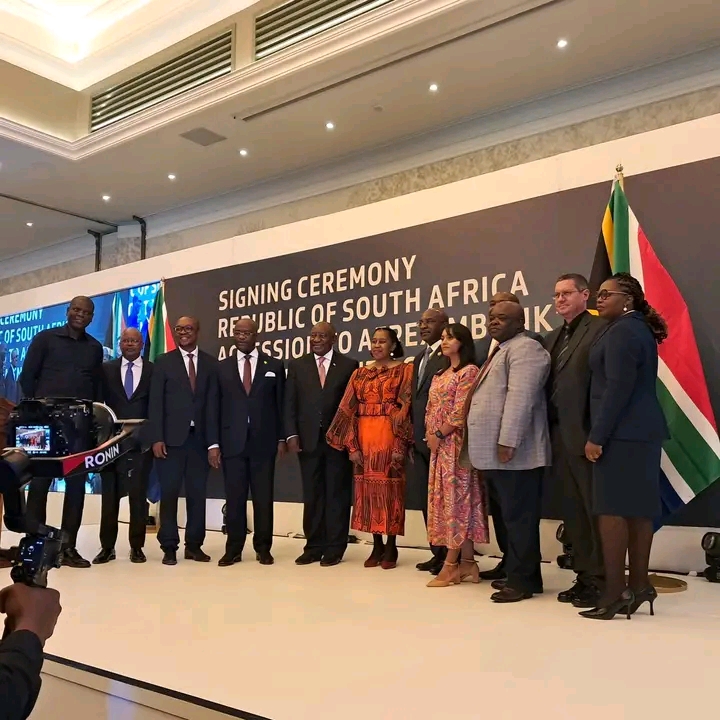
The signing ceremony, held in Johannesburg and attended by President Cyril Ramaphosa, senior government officials, diplomats and business leaders, marked what Afreximbank President and Chairman of the Board, Mr. George Elombi, described as a “decisive step towards uniting Africa around its shared economic destiny.”
Speaking at the event, Elombi said South Africa’s accession completed Afreximbank’s vision of full continental coverage and placed the country “at the very heart of the Bank’s mission to transform the structure of Africa’s trade.”
“Today, we assume full responsibility for our economic destiny,” he declared, stressing that Africa could no longer rely on external benevolence in a changing global order where multilateralism is increasingly under strain.
As part of the accession, Afreximbank announced an US$8 billion country programme for South Africa, developed in partnership with the Department of Trade, Industry and Competition (DTIC) under Minister Parks Tau. The programme is aligned with South Africa’s National Development Plan 2030 and focuses on industrialisation, infrastructure development and private-sector-led growth.
Key priority areas include heavy investment in local processing of natural resources to retain value within the economy, expansion of automotive manufacturing, and the development of industrial parks and special economic zones. Afreximbank also plans major investments in critical infrastructure, particularly energy generation and transmission, to support industrial production.
The Bank will further facilitate South Africa’s access to regional and continental markets under the African Continental Free Trade Agreement (AfCFTA), while working with institutions such as the Industrial Development Corporation (IDC), Development Bank of Southern Africa (DBSA), Public Investment Corporation (PIC) and leading commercial banks to drive economic transformation.
Elombi revealed that within the broader US$8 billion package, Afreximbank has designed a US$3 billion inclusive finance programme targeted at marginalised and vulnerable segments of the South African economy, including small and medium-scale enterprises (SMEs).
The Bank also pledged to support institutional capacity-building, including plans to assist in transforming South Africa’s Export Credit Insurance Corporation (ECIC) into a fully fledged Eximbank capable of driving industrial development and economic diversification.
Long-Standing Partnership
While South Africa’s formal accession is new, Elombi noted that Afreximbank has been a significant investor in the country for years.
These include a US$1 billion South Africa–Africa trade and investment promotion programme launched in 2018, financing support for Eskom and Transnet, participation in the Mozambique LNG project, and backing for industrial and mining ventures.
In September 2025, Afreximbank and the South African government also signed a US$20 million project preparation facility expected to unlock up to US$750 million in bankable infrastructure projects across energy, transport, logistics and digital sectors.
According to Elombi, Afreximbank’s current project pipeline in South Africa exceeds US$6 billion, spanning healthcare, manufacturing, energy, mining and financial services.
Paying tribute to President Ramaphosa’s leadership, Elombi said South Africa’s accession revived a three-decade ambition pursued by successive Afreximbank leaders, including former President Prof. Benedict Oramah.
“We are here first and foremost as Africans, before we are bankers,” he said. “Our success will be measured by how well we serve the people of South Africa and the wider African continent.”
The accession is widely seen as a major boost for Africa’s push toward deeper economic integration, industrialisation and self-reliance, with South Africa now positioned to play a central role in reshaping intra-African trade and investment flows.
