
… Calls for Stronger Female Leadership
By| Goodluck E.Adubazi | Abuja
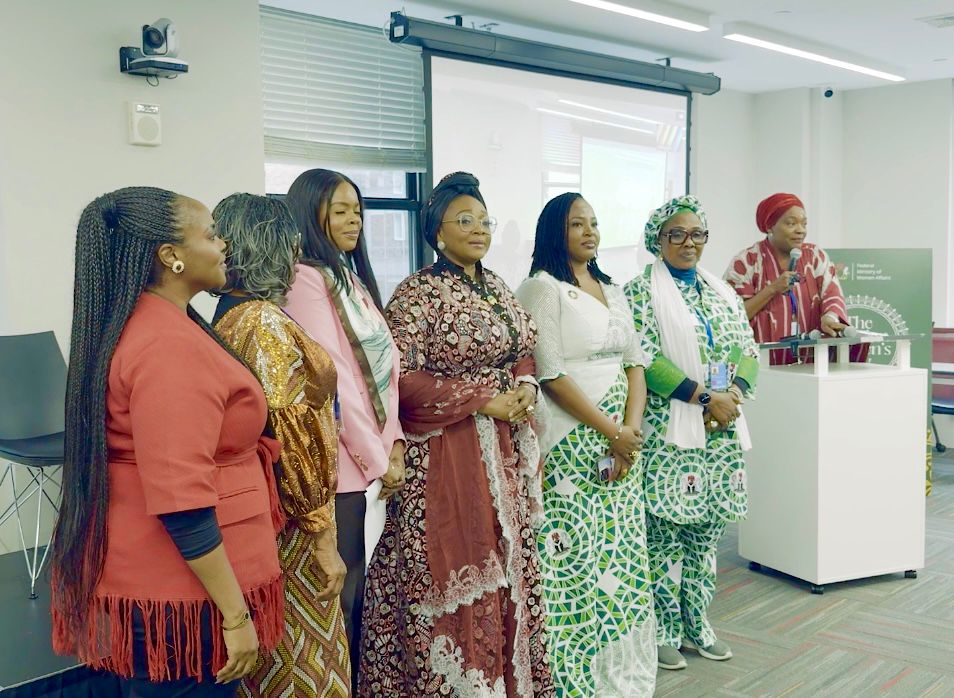
The exclusion of women from decision-making positions weakens democracy, slows development and limits a nation’s ability to deliver fairness and opportunity, the United Nations Deputy Secretary-General, Amina J. Mohammed, has said, at this year’s Womens day celebration in New York.
Speaking during the celebration of International Women’s Day and at the second edition of Nigerian Women’s Day held on the sidelines of the Commission on the Status of Women 70 in New York, Mohammed stressed that justice and inclusive governance are central to sustainable development.
According to her, nations that exclude women from leadership are limiting their own potential.
“The foundations of human rights and women’s rights are about justice,” she said, adding that when women are left out of governance, countries attempt to progress “with only half the wings of the bird.”
She warned that the absence of women in leadership weakens democratic institutions and undermines development outcomes, stressing that women’s rights must be treated as fundamental justice rather than a concession.
Mohammed also underscored the importance of achieving gender equality under the United Nations Sustainable Development framework.
“Without Goal 5, there are no SDGs,” she said, referring to the global target on gender equality.
She further noted that the world is currently facing what she described as a “drought of leadership,” suggesting that values-driven and inclusive women’s leadership could help address global governance challenges.
Advocates have also renewed calls for the implementation of the 35 percent women affirmative representation in governance, arguing that such a policy would help reverse decades of underdevelopment, leadership decay and weak institutional governance.
Many voices across policy and civil society circles believe that meaningful implementation of the affirmative action policy could significantly change the development trajectory of nations by ensuring that women participate actively in decision-making processes.
At the event, Nigeria’s Minister of Women Affairs, Imaan Sulaiman‑Ibrahim, delivered the keynote address, declaring that the era of policy promises has ended.
“The time for promises has passed. The time for action is now,” she said.
She argued that women’s empowerment must be treated as a national development strategy rather than a social welfare issue, describing it as an economic, security and development imperative.
She introduced the Real Hope Social Impact Intervention 774, a national delivery framework designed to reach women across all 774 local government areas in Nigeria. The initiative focuses on multiple sectors including energy, agriculture, digital inclusion, healthcare, leadership development, education, child welfare and family support.
The minister urged women to organise politically, support one another and intentionally claim leadership roles in governance and political representation.
“Women must invest in one another and stand in solidarity to shape the future of governance,” she said.
Strategic Dialogue on Women’s Leadership
A fireside conversation between Mohammed and Sulaiman-Ibrahim focused on the broader global message that inclusive governance and women’s leadership are essential for democracy and development.
Both leaders emphasised that women’s participation in governance goes beyond symbolic representation and extends to shaping laws, national budgets, institutions and long-term development policies.
The strategic meeting, which aimed at positioning women at the forefront of leadership and governance, was attended by several stakeholders and advocates for gender inclusion.
Among those present was Enene Ejembi, Executive Director of Verbatim Virtual Solutions, who participated in discussions focused on strengthening women’s voices and leadership in national and global policy spaces.