
By| Goodluck E.Adubazi, Abuja
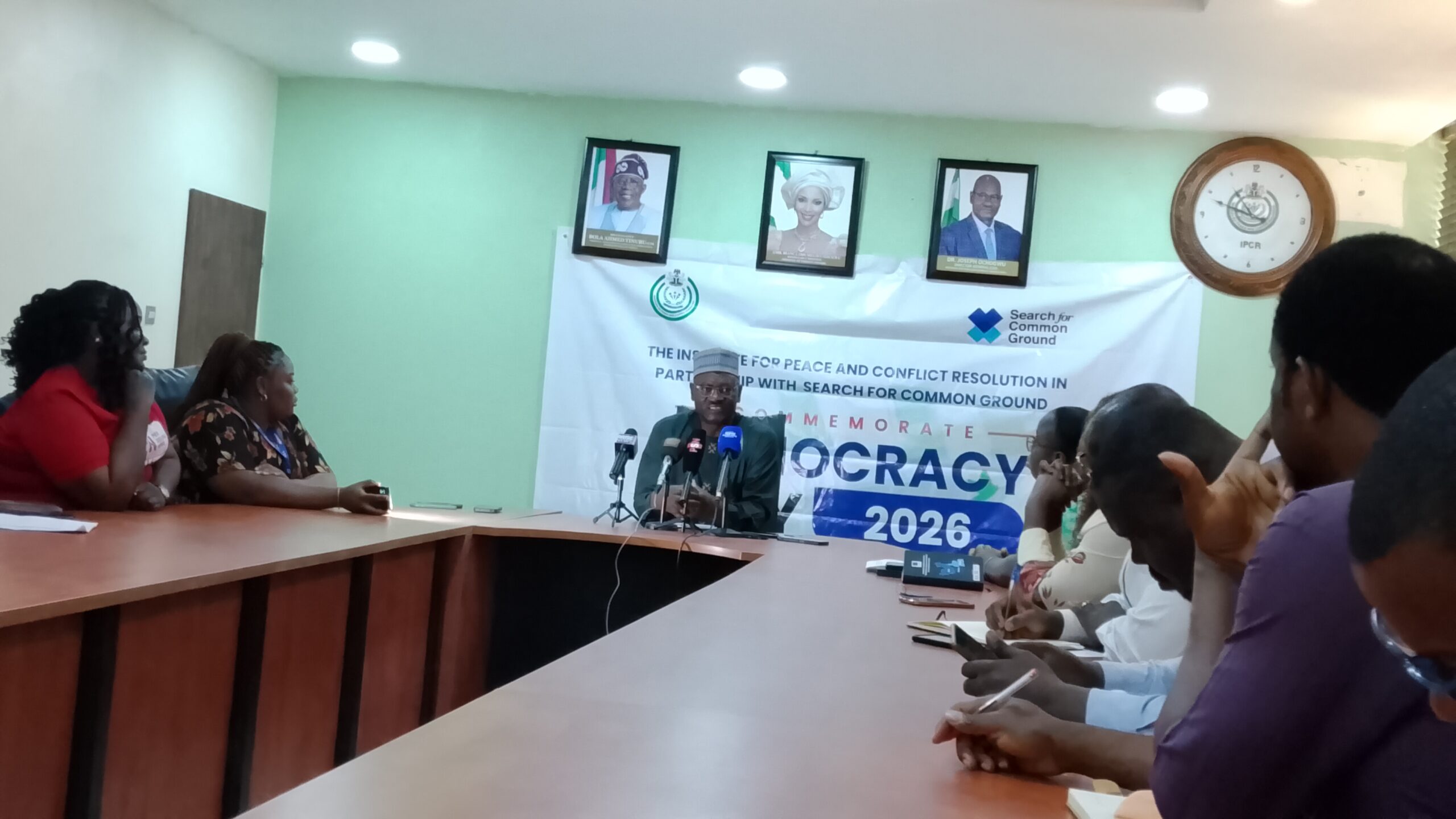
The Director-General of the Institute for Peace and Conflict Resolution (IPCR), Dr. Joseph Ochogwu, has stated that Nigeria’s democratic future remains promising but warned that its survival and growth depend on deliberate efforts by citizens, institutions, and stakeholders to protect and strengthen democratic values.
Reflecting on the occasion of Democracy Day 2026, Ochogwu said democracy remains the most effective system of governance for ensuring accountability, citizen participation, peaceful leadership transitions, and the protection of human rights.
In a statement on Thursday, at the Institute headquarters, on behalf of the Governing Council, management, and staff of the institute, the IPCR boss described the celebration as a moment for national reflection, assessment of democratic progress, and renewed commitment to peace, governance, and national unity.
According to him, many of the challenges confronting Nigeria’s democracy stem not from the democratic system itself but from inadequate citizen participation, weak democratic culture, voter apathy, limited civic knowledge, and declining engagement in governance processes.
He noted that findings from the institute’s conflict assessments and field interventions consistently show that democratic pressures are often linked to citizens’ disengagement rather than flaws in democracy as a concept.
“Democracy cannot be sustained by institutions alone. It requires an active, informed, and vigilant citizenry,” Ochogwu stated.
The IPCR Director-General expressed concern over growing voter apathy, particularly among young people and urban residents, describing it as a major threat to democratic consolidation.
He attributed the trend to declining trust in public institutions, fear of electoral violence, misinformation, and the perception that individual votes do not matter.
He urged Nigerians, especially the youth, to reject political apathy and embrace active participation in elections and governance processes.
“Democracy is weakened when citizens withdraw from participation. Elections are not merely periodic political events but the primary means through which citizens exercise sovereignty and hold leaders accountable,” he said.
Ochogwu also warned against electoral violence, intimidation, hate speech, and coercive political practices, saying they continue to undermine democratic credibility and national stability.
He called on political parties, security agencies, electoral institutions, civil society organisations, the media, and citizens to recommit themselves to peaceful political competition driven by ideas, policies, and leadership competence rather than violence or manipulation.
The IPCR chief further raised concerns about the increasing monetisation of politics, saying the high cost of political participation has effectively excluded many qualified Nigerians from contesting for public office.
“When access to political office is determined primarily by financial capacity, democracy risks becoming exclusionary.
This weakens representation, erodes public trust, and disconnects governance from the aspirations of ordinary citizens,” he said.
Ochogwu advocated reforms aimed at reducing the influence of money in politics and promoting broader participation by competent and public-spirited citizens.
He also called for stronger group-based political engagement through professional associations, labour unions, youth organisations, women’s groups, and community networks, arguing that such structures would improve accountability and make democratic participation more issue-driven.
While expressing optimism about Nigeria’s democratic future, he stressed that democracy must evolve beyond elections to deliver peace, justice, inclusion, development, and a sense of belonging for all citizens.
The IPCR Director-General emphasized that state and local government institutions remain critical to democratic consolidation because they are closest to the people and directly impact daily lives through service delivery and community development.
He further highlighted the growing influence of social media and digital platforms in shaping public opinion, urging responsible use of such channels to promote peace, voter education, civic participation, and the fight against misinformation.
Ochogwu warned that democracy now faces emerging threats from terrorism, banditry, violent extremism, and transnational organised crime, noting that insecurity remains a direct challenge to democratic stability.
He disclosed that the IPCR, in collaboration with the Federal Ministry of Foreign Affairs, has continued to advance a Regional Partnership for Democracy initiative aimed at promoting constitutional governance, human rights, and democratic values across Africa in line with President Tinubu’s 4-D foreign policy.
Reaffirming the institute’s commitment to peacebuilding and democratic governance, Ochogwu called for stronger safeguards against electoral violence, greater youth involvement in leadership, expanded civic education, and more credible and inclusive elections.
“As we commemorate Democracy Day 2026, let us renew our collective resolve to defend democratic values, protect civic space, and strengthen our institutions. Let us reject apathy, violence, and division, and ensure that democracy in Nigeria becomes more inclusive, peaceful, and responsive to the needs of all citizens,” he said.
Meanwhile, the Director of Programmes at Search for Common Ground, Gift Omoniwa, has called for collective action to safeguard Nigeria’s democracy, warning that electoral violence remains a serious threat to democratic consolidation, national unity, and sustainable development.

In a statement on Thursday in Abuja, while reflecting on the 27 uninterrupted Nigeria Democratic journey, Omoniwa described the occasion as a reminder of Nigeria’s democratic journey and the shared responsibility of citizens and institutions to strengthen democratic values.
She acknowledged the progress made since the country’s return to democratic rule but expressed concern over persistent incidents of political intimidation, hate speech, voter suppression, misinformation, destruction of property, and physical attacks during election periods.
According to her, such actions continue to undermine public confidence in elections and weaken trust in democratic institutions.
“Electoral violence remains one of the most significant challenges confronting democratic processes. It threatens lives and livelihoods while discouraging meaningful citizen participation in governance,” she said.
Omoniwa stressed that elections should provide citizens with an opportunity to freely express their choices through peaceful and lawful means.
She noted that democratic competition should be based on ideas, policies, and service delivery rather than violence, coercion, and divisive rhetoric.
The organisation also urged Nigerian youths to reject attempts by politicians and other actors to use them as instruments of violence during elections.
Instead, young people were encouraged to become ambassadors of peace, dialogue, civic responsibility, voter education, community mobilisation, advocacy, and constructive engagement.
Looking ahead to future electoral cycles, Omoniwa reaffirmed Search for Common Ground’s commitment to supporting initiatives that strengthen democratic governance, encourage citizen participation, promote social cohesion, and foster sustainable peace across Nigeria’s communities.