
• Imo governor says economic growth means little if citizens remain poor, uneducated and excluded from opportunities
By | Goodluck E. Adubazi, Abuja
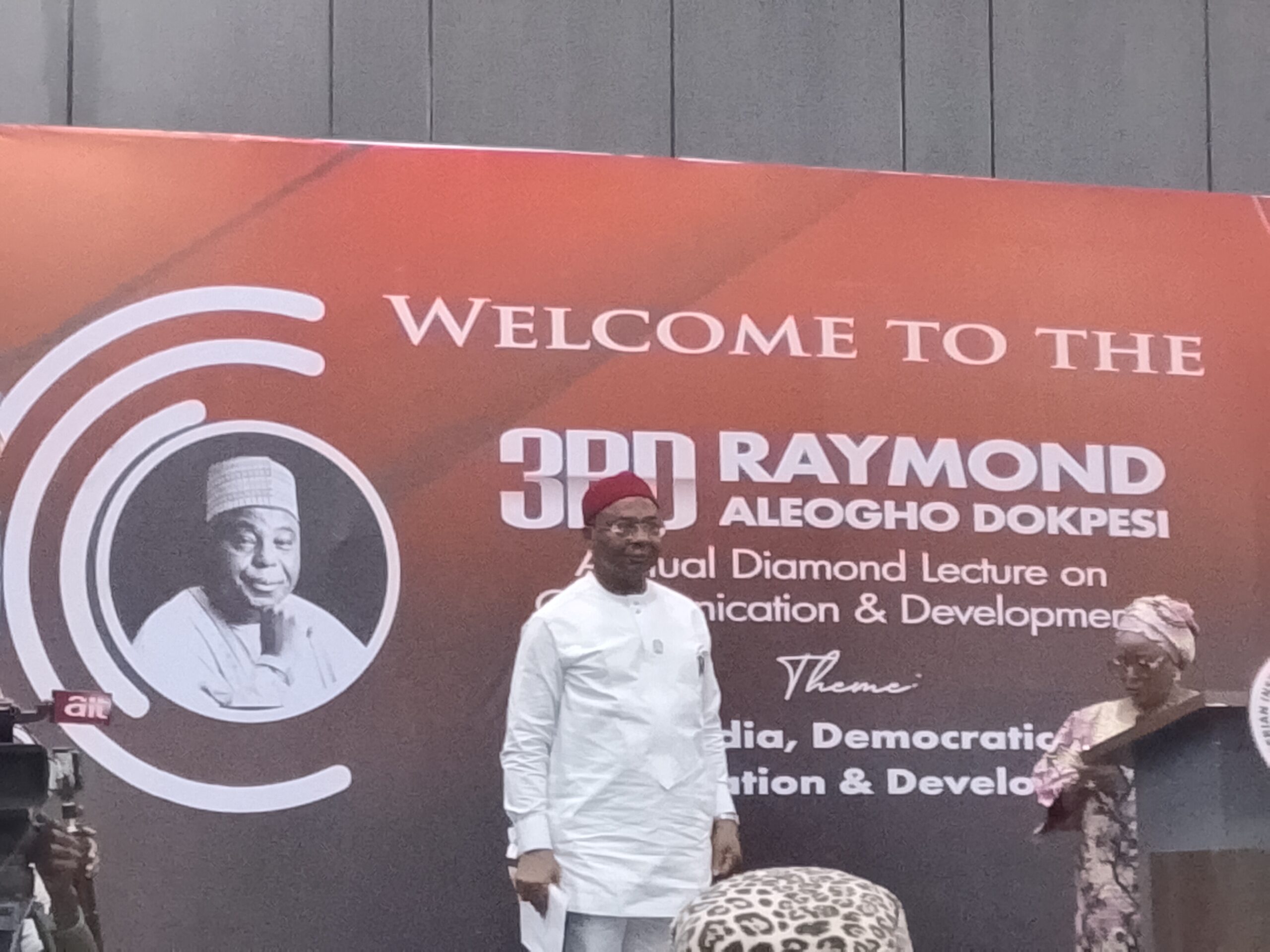
Imo State Governor, Hope Uzodimma, has said Nigeria’s democracy would be better served if the media could pursue the truth without intimidation, urging the government and public institutions to embrace scrutiny and strengthen accountability.
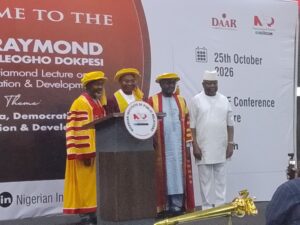
Uzodimma, who spoke as the guest lecturer at the 3rd Raymond Aleogho Dokpesi Annual Diamond Lecture on Communication and Development, said press freedom, democratic consolidation and national development were interconnected and essential to building a stronger democratic society.
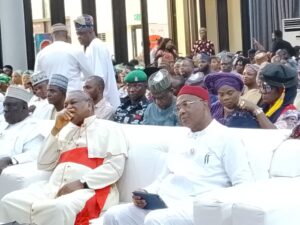
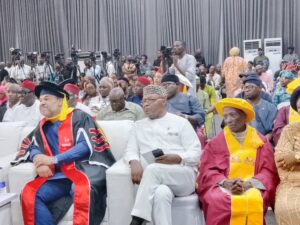
The lecture, themed “Media, Democratic Consolidation and Development,” was held at the NAF Conference Centre, Abuja, on Sunday, October 25, 2026.
The governor stressed that democracy could only flourish when journalists were free to investigate public affairs, expose wrongdoing and provide citizens with credible information to make informed decisions.
“Our democracy will be better served when the media can pursue the truth without intimidation,” he said.
According to him, democratic institutions must be strong enough to withstand scrutiny, while governments must accept accountability and respond appropriately to established facts.
He argued that the media played a crucial role in connecting democratic accountability with development by ensuring that citizens were informed about government policies, public expenditure and decisions affecting their lives.
Uzodimma explained that democratic consolidation went beyond conducting elections periodically, noting that it required the protection of fundamental rights, respect for the rule of law, effective institutions and peaceful constitutional transfers of power.
He maintained that elections alone did not guarantee a firmly established democracy, adding that citizens must have access to reliable information and competing political viewpoints to make informed choices.
The governor also cautioned against measuring national development solely by economic growth, stressing that increased national wealth did not automatically translate into improved living conditions for ordinary Nigerians.
“An economy may grow while large numbers of citizens remain poor, remain uneducated, remain unhealthy or excluded from opportunities,” he said.
He explained that development should be assessed through economic growth, education, healthcare, social equality, improved living standards and expanded opportunities for citizens.
According to him, a country’s development must be measured by the extent to which its people enjoy better living conditions and greater opportunities, rather than by economic statistics alone.
Addressing the changing media landscape, Uzodimma observed that technological advancement had expanded the reach of journalism through websites, podcasts, streaming platforms, mobile applications and social media networks.
However, he warned that the ability to publish information online did not automatically make everyone a journalist.
He said professional journalism required fact-checking, verification, context and accountability, particularly at a time when artificial intelligence was making fabricated information increasingly convincing.
The governor also identified government intimidation, ownership influence, dependence on major advertisers, poor remuneration, political affiliations and the pursuit of online traffic as factors capable of undermining editorial independence.
He argued that genuine media independence required editorial autonomy, professional competence, ethical discipline, public trust and a sustainable economic foundation for media organisations.
Uzodimma, however, emphasised that press freedom must be accompanied by responsibility, warning that unverified allegations and sensational reporting could damage reputations, mislead the public and undermine confidence in democratic institutions.
He said journalism should remain committed to truth, fairness, constitutional order and the public interest rather than the political fortunes of individual candidates or parties.
Speaking from the perspective of a public officeholder, the governor acknowledged that politicians sometimes considered media reports unfair or incomplete but maintained that such experiences did not justify weakening the press.
He argued that any public official demanding exclusively favourable coverage was effectively asking journalists to function as a government publicity department.
The governor further highlighted the growing challenges posed by artificial intelligence, digital manipulation and misinformation, urging journalists to strengthen verification and professional standards.
He noted that while the media could expose societal problems and bring them to public attention, other institutions must take responsibility for investigating allegations, enforcing the law and implementing corrective measures.
According to him, reporting electoral malpractice, for instance, must be followed by appropriate action from electoral authorities and law enforcement agencies where violations are established.
He stressed that the media could not independently resolve every problem it uncovered, making cooperation among journalists, government institutions and accountability agencies necessary for democratic progress.
Uzodimma also commended the Governing Council of the Nigerian Institute of Public Relations for instituting the lecture series, which dates back to the diamond jubilee celebration in 2024.
He congratulated the family of the late media entrepreneur, High Chief Raymond Aleogho Dokpesi, and DAAR Communications Plc for sustaining his legacy.
The governor described Dokpesi as a visionary who demonstrated the courage and determination to establish DAAR Communications, with its flagship media outlets, African Independent Television (AIT) and Raypower FM.
He said Dokpesi deserved recognition among Nigerians whose contributions had secured enduring places in the country’s history.
Uzodimma also traced the development of Nigerian journalism to the establishment of Iwe Irohin in Abeokuta in 1859 by Reverend Henry Townsend, followed by the Daily Times in 1926, the West African Pilot in 1937 and Tribune in 1947.
He noted that media institutions established by prominent nationalists and entrepreneurs had helped preserve their legacies and shape Nigeria’s political and social development.
The governor urged the present custodians of such institutions to protect and sustain them for future generations.
He concluded that a free, credible and responsible media remained indispensable to democratic consolidation, accountable leadership and inclusive national development, particularly as Nigeria prepares for another round of general elections.