
By| Goodluck E.Adubazi, Abuja
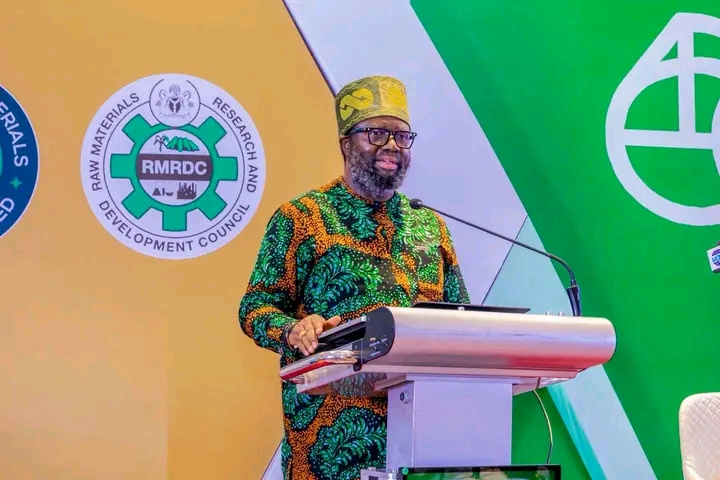
The Director-General and Chief Executive Officer of the Raw Materials Research and Development Council (RMRDC), Prof. Nnanyelugo Ike-Muonso, has called for strategic partnerships, increased diaspora investment and improved workforce capacity to accelerate Nigeria’s industrialisation through domestic processing and value addition.
Ike-Muonso said Nigeria possesses enormous untapped agricultural, mineral and industrial waste resources capable of transforming the economy, creating jobs and strengthening the country’s global competitiveness if properly harnessed.
He made the call while delivering a lecture titled *“Unlocking Nigeria’s Raw Material Value Chain for Industrialisation, Manufacturing and Competitiveness,”* where he identified a combined $2.65 trillion global market opportunity across 30 major raw material value chains.
The opportunities comprise 12 agricultural value chains valued at $932 billion, 11 mineral value chains worth $1.352 trillion and seven circular-economy value chains estimated at $366 billion.
The RMRDC boss lamented that Nigeria’s manufacturing contribution to real Gross Domestic Product declined from 9.64 per cent in 2014 to 8.05 per cent in 2025, representing a 16.5 per cent reduction.
He also disclosed that raw material imports increased to $20.5 billion in 2025, approximately six times the 2020 level, warning that excessive dependence on imported industrial inputs exposes manufacturers to foreign exchange volatility and higher production costs.
According to him, Nigeria must transition from exporting raw commodities to developing competitive industries capable of producing intermediate materials, industrial inputs and finished products.
Highlighting the country’s agricultural potential, Ike-Muonso said Nigeria produces over 63 million metric tonnes of cassava annually, yet more than 80 per cent of agricultural output leaves farms without adequate processing.
He identified cassava, cocoa, cotton, natural rubber, oil palm and maize derivatives as priority investment opportunities.
In the solid minerals sector, he cited over 44 commercially viable minerals across more than 500 locations, including lithium, gold, barite, bitumen, iron ore and limestone.
He also identified electronic waste, scrap metals, plastics and agricultural residues as valuable industrial feedstock, noting that Nigeria generates over 32 million tonnes of solid waste annually.
To address structural challenges, the DG highlighted RMRDC’s proposed 30 per cent Value Addition Bill and the Nigeria Integrated Information Statistical System for Raw Materials and Products (NISSRAMP), describing them as critical interventions for promoting local processing and providing reliable investment data.
He urged government, academia and industry to strengthen collaboration in developing bankable projects, processing facilities and industrial infrastructure.
The RMRDC chief executive particularly called on Nigerians in the diaspora and international investors to bring financial resources, technology, technical expertise and global business networks into the country’s raw materials sector.
He further highlighted industrial processing parks, mineral refining, agro-industrial platforms, battery recycling and industrial input manufacturing as viable investment opportunities.
Ike-Muonso also underscored the importance of workforce development, research, innovation and improved working conditions, citing the establishment of the RMRDC Training School and rewards for winners of the Council’s Innovation Challenge as evidence of his administration’s commitment to institutional development.
He noted that the Council’s achievements had attracted national and international recognition, including the Al-Jazirah Double Honour Awards as Public Servant/Government Agency of the Year 2024–2025 and his recent election as Sub-Saharan Africa Regional Representative on the Board of the World Association of Industrial and Technological Research Organisations (WAITRO).
Concluding the lecture, he charged RMRDC staff, researchers, manufacturers and investors to embrace their roles as nation-builders, stressing that Nigeria’s industrial future depends on its ability to transform abundant natural resources into globally competitive products.