

By| Goodluck E.Adubazi, Abuja
The Independent National Electoral Commission (INEC) has said it will deploy about 1.4 million personnel to more than 176,000 polling units across the country for the 2027 general elections.

INEC Chairman, Prof. Joash Ojo Amupitan, disclosed this on Tuesday in Abuja at the signing of the first National Peace Accord by political parties and candidates ahead of the 2027 general elections.



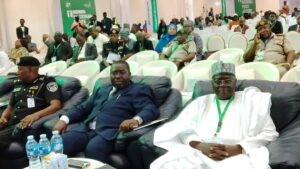
The event was organised by the National Peace Committee, in collaboration with the Kukah Centre and the European Union, ahead of the official commencement of campaigns on Wednesday, August 19, 2026.
Amupitan assured Nigerians that the commission was fully prepared for the elections, declaring that INEC had no preferred candidate or political party.
“The commission does not have a candidate, nor does it favour any political platform. Our only interest is in a lawful, transparent, credible and inclusive process,” he said.
According to him, INEC would remain an impartial umpire committed to providing a level playing field for all political parties and candidates.
“INEC is ready. Nigeria is expectant,” Amupitan said, urging political actors to make the 2027 election a contest of ideas rather than a battle for supremacy.
He said, “Let the 2027 campaign be a marketplace of ideas, not a theatre of war.”
The INEC chairman noted that the presidential and National Assembly elections are scheduled for January 16, 2027, while the governorship and State Houses of Assembly elections will hold on February 6, 2027.
He said the signing of the Peace Accord on the eve of the commencement of campaigns was deliberate, stressing that political parties and candidates must establish ethical boundaries for their campaigns before political activities intensify.
Amupitan warned against the growing use of hate speech, character assassination, identity-based provocation, misinformation and inflammatory rhetoric in political discourse.
He said Nigerians were more interested in concrete solutions to the country’s economic, security and developmental challenges than insults and personal attacks.
According to him, political parties should present clear and measurable manifestos addressing economic growth, national security, infrastructure, healthcare, education and inclusion.
He also urged candidates and party leaders to lead by example, noting that supporters often take their cues from the statements and conduct of their leaders.
“Your supporters look to you for cues. If you speak the language of peace, they will act it. If you incite them, they will follow,” he said.
Amupitan further urged political parties to respect electoral laws, security agencies, electoral institutions and the outcome of the democratic process.
He said the commission had spent the past eight months strengthening its technology, logistics and personnel ahead of the 2027 elections.
The INEC chairman said the commission’s preparations had been tested through recent elections, including the Anambra State governorship election, the FCT Area Council elections, the Ekiti State governorship election and the recently concluded Osun State governorship election, alongside several bye-elections.
He, however, stressed that INEC alone could not guarantee peaceful and credible elections.
“An election is like a game. INEC may provide the pitch and the referee, but the quality of the game depends on the players,” he said.
Amupitan commended the security agencies for their role in maintaining peace during recent elections, stressing that there could be no successful election without security and peace.
Also speaking, the Inspector-General of Police, IGP Rilwan Disu, represented at the event by the Deputy Inspector-General of Police, DIG Shehu, said the Nigeria Police Force had no interest in determining who wins or loses the 2027 elections.
“We have no interest in who wins or loses an election. Our interest is in ensuring that every Nigerian is able to participate in the democratic process freely, safely and without fear,” he said.
The IGP said the police would work with INEC, the military, intelligence agencies and other security and law enforcement institutions to provide the security environment required for political activities and credible elections.
He, however, warned political parties and candidates against using thugs, armed groups, criminal elements or other illegal structures to intimidate opponents, disrupt political meetings or interfere with the electoral process.
Disu also warned against the acquisition, distribution or use of illegal firearms and other weapons for political purposes.
He urged political parties to take responsibility for the conduct of their supporters, campaign organisations and agents.
“You cannot publicly preach peace while privately authorising violence,” he warned.
The IGP also called for the inclusion of youths, women, persons with disabilities and other traditionally underrepresented groups in political activities without intimidation or discrimination.
Earlier, Chairman of the National Peace Committee, former Head of State, General Abdulsalami A. Abubakar, GCFR, said the Peace Accord was designed to promote issue-based political campaigns and peaceful competition.
Abubakar said the committee had facilitated 25 peace accords at the sub-national level, including in states conducting off-cycle elections, while establishing state-based peace structures in 23 states.
He explained that the issue-based campaign Peace Accord, established in 2019, was aimed at encouraging political parties and candidates to compete on the basis of ideas, policies and programmes.
According to him, the accord requires political actors to debate opposing views respectfully, mobilise supporters peacefully, protect voters, respect electoral institutions and reject hate speech, incitement, misinformation and narratives capable of provoking violence.
He lamented that political campaigns in Nigeria had increasingly been characterised by name-calling, personal insults and character assassination at the expense of party manifestos and policy proposals.
Abubakar urged political parties, candidates, campaign councils and spokespersons to campaign on issues of importance to Nigerians, avoid fake news and personal attacks, and promote tolerance and decency.
He said the Peace Accord was anchored on the Constitution, the Electoral Act and other relevant laws, making compliance with its provisions part of the broader legal obligations of political actors.
He also announced the Peace Committee’s Election Security Information (ESI) initiative, designed to monitor election-related security developments, identify threats and support early warning, preventive engagement and evidence-based decision-making.
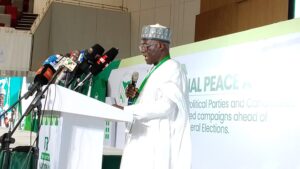


In a presentation on emerging issues, the Kukah Centre Secretariat said the country was 152 days away from the presidential election and 172 days away from the governorship and State Houses of Assembly elections.
The centre said the objective of the accord was to ensure that political competition did not become hostility, disagreement did not become hatred, mobilisation did not become intimidation, electoral disputes did not become conflicts and information did not become a weapon against electoral integrity.
It said an assessment of previous Peace Accord commitments showed significant breaches, particularly in the area of issue-based campaigns.
According to the presentation, about 43 per cent of recorded breaches related to the commitment to conduct issue-based campaigns, while 13.5 per cent involved insults and violence and nine per cent concerned fake news and disinformation.
The centre further said 58 per cent of violations relating to issue-based campaigning were attributed to political party spokespersons, with 32 states affected. Kano, Lagos, Rivers and Benue were identified among the states most affected.
The centre warned that political language could become a risk signal capable of escalating tension and violence if not properly managed.
National Chairman of the Inter-Party Advisory Council (IPAC), Yusuf Dantalle, in his peace message, called for peace, inclusion and justice throughout the electoral process.
Dantalle said democracy was about the inclusion of every segment of society, irrespective of political or religious affiliation.
He urged political leaders to ensure that any government produced through the electoral process enjoyed legitimacy and the confidence of Nigerians.
While commending the National Peace Committee for convening the political actors, Dantalle warned that peace without justice could become an illusion.
He called for closer scrutiny of actions by political actors and state institutions that could undermine fair competition, including the use of government institutions to frustrate opponents’ campaigns or impose excessive charges on campaign materials.
Dantalle urged stakeholders to ensure that the 2027 elections were conducted in an atmosphere of fairness, justice and peaceful political competition.
With campaigns officially commencing on Wednesday, August 19, the stakeholders urged political parties, candidates and their supporters to prioritise issues, respect democratic institutions and reject violence, hate speech, misinformation and intimidation.
The signing of the accord marked a collective commitment by political parties and candidates to peaceful, issue-based campaigns and to ensuring that the 2027 general elections strengthen rather than undermine Nigeria’s democratic development.