
By | Goodluck E. Adubazi, Abuja
The Bill & Melinda Gates Foundation and leading development, economic and policy experts have called for urgent innovation in Nigeria’s local governance systems to ensure that government policies and development interventions translate into tangible improvements in the lives of citizens at the grassroots.
The call was made on Wednesday during the second day of the GS-26 Forum in Abuja, at a plenary session focused on “Innovation in Local Governance Systems for Better Service Delivery at the Last Mile.”
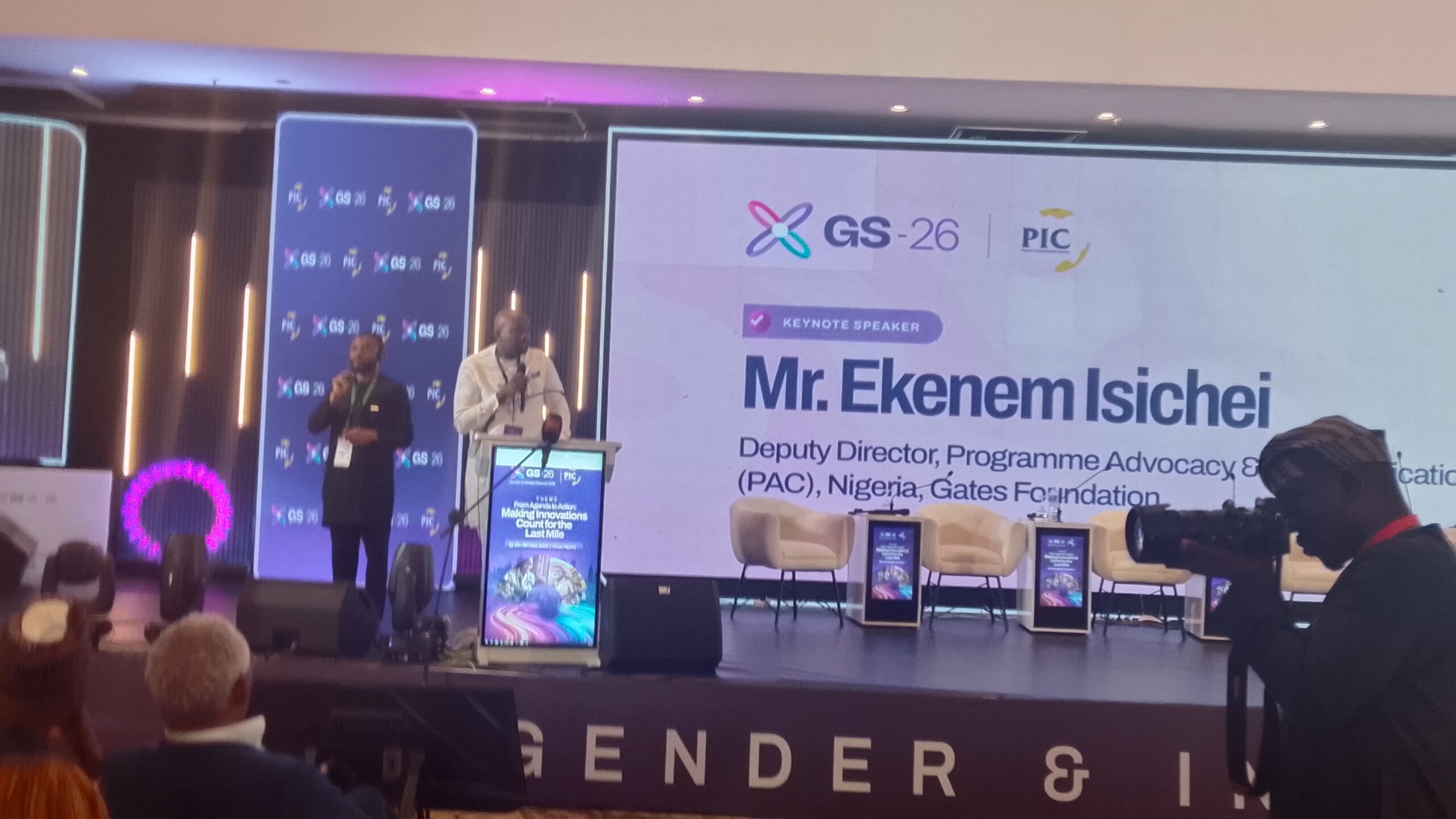
Delivering the keynote address, Mr. Ekenem Isichei, Deputy Director, Programme, Advocacy and Communications (PAC), Nigeria, Gates Foundation, said Nigeria must bridge the gap between good ideas and services that ordinary people can actually access and use.
Isichei said innovation should not be measured merely by the number of policies announced or pilot projects launched, but by whether such interventions produce clear and measurable improvements in the lives of the people they are designed to serve.
According to him, the concept of the “last mile” should not be seen simply as a geographical location but as the individual whose life depends on whether public services work.
“The last mile is not a place on the map; it is actually a person,” Isichei said.
He explained that the last mile could be a pregnant woman unable to access life-saving healthcare, a survivor of gender-based violence disconnected from protection and justice services, a woman entrepreneur unable to access finance and markets, or a person with disability confronting services that were never designed to accommodate them.
Using the example of two women who visited a hospital but experienced different outcomes, Isichei stressed that gaps in healthcare systems could mean the difference between life and death.
He described innovation as “the distance between a good idea and a service that you can actually use,” urging policymakers and development partners to focus on closing that gap.
The Gates Foundation official identified three major aspirations driving the organisation’s interventions: ensuring that no child dies from preventable causes, eliminating major infectious diseases such as malaria and tuberculosis, and supporting efforts to lift people out of poverty.
He said Nigeria must move beyond broad commitments to specific, measurable actions capable of delivering visible results, particularly as the country approaches another election cycle.
Isichei also challenged stakeholders to ask critical questions about public investments and policies.
“Where are the resources? How are they being utilised? Are they reaching the last mile? Are the people around us actually witnessing the change that we want to see?” he asked.
He further urged Nigeria to ensure that digital services are affordable, accessible and useful to underserved communities.
According to him, access to a mobile phone, a National Identification Number or a bank account does not automatically translate into meaningful inclusion unless the services available through those platforms genuinely meet people’s needs.
The Deputy Director also warned against Nigeria’s growing dependence on pilot programmes, saying the country must move from “pilots, pilots, pilots” to sustainable systems that can be scaled across communities.
“We need to move beyond pilots to actually successful systems,” he said, adding that innovation must build trust within communities and deliver lasting solutions rather than temporary interventions.
Isichei said the ultimate test of every intervention should be whether it removes identifiable barriers, assigns responsibility, establishes timelines and produces evidence that people’s lives have genuinely improved.
“The last mile is not where ambition disappears,” he said. “It should be where innovation becomes visible and where innovation proves valuable.
The plenary discussion, however, revealed deeper concerns about the disconnect between policies formulated at national and state levels and the realities experienced by citizens at the grassroots.
One of the speakers, who spoke from the perspective of the Nigerian Economic Summit Group (NESG), said Nigeria’s development challenge was increasingly becoming a question of how interventions reach citizens at the local level.
He said that since 2022, the NESG had increasingly moved beyond macroeconomic discussions to examine why development interventions often fail to reach the last mile.
According to him, one major problem is what he described as the “disappearance of the experience of citizenship.”
He explained that while citizens may know on paper that they are entitled to healthcare, education and other public services, those services are often unavailable in their communities.
A second challenge, he said, is the existence of gatekeeping and patronage systems that prevent ordinary citizens from accessing services unless they have connections to influential individuals.
“If I cannot access the big man in my local government, I cannot access the services,” he said.
He identified the absence of strong coalitions among government institutions, civil society organisations and communities as another major obstacle to effective service delivery.
According to him, policies can be perfectly designed in Abuja but still fail if the systems required to deliver them do not function at the grassroots.
He called for innovation in three major areas — coalitions, data and service delivery.
The NESG representative said household-level data should become the foundation for measuring development outcomes rather than relying exclusively on broad macroeconomic indicators.
While indicators such as GDP growth, foreign reserves and inflation may suggest economic progress, he said household-level realities often reveal a different picture.
“What is happening in the food basket at household level? What is household income looking like? How much can people actually spend?” he asked.
He said Nigeria needs data systems that show what is happening within individual communities and wards, particularly in areas such as health, education, sanitation, employment and livelihoods.
Another speaker at the forum emphasised the importance of coordinated and properly analysed data, warning that poorly coordinated statistics could lead policymakers to make wrong decisions.
The speaker called for the creation of development “barometers” at ward level to monitor local economic activities, school enrolment, primary healthcare challenges and the performance of small and medium-scale enterprises.
He noted that many political and economic statistics remain concentrated at national and state levels, while information about what is happening closest to citizens is often unavailable.
According to him, national indicators such as GDP growth and declining inflation become meaningful only when citizens experience improvements in their daily lives.
He said policymakers should be able to answer basic questions about the number of businesses operating in communities, market activities, school enrolment and challenges facing primary healthcare facilities.
Participants also raised concerns about the exclusion of communities from the process of developing policies intended to affect them.
A development practitioner working on environmental issues said communities are frequently expected to implement policies they neither participated in designing nor fully understand.
She said this disconnect creates a major gap between government policies and local realities.
According to her, communities possess indigenous knowledge and experience that should be incorporated into policymaking rather than ignored.
“The communities we are talking about are not dumb,” she said, stressing that they need an enabling environment to develop solutions that work for their people.
She warned that conflicting figures from national, state and local levels often make effective planning difficult.
The speaker said meaningful results would remain difficult to achieve if local government officials, state authorities and community representatives were excluded from discussions where decisions about their needs were being made.
Another panelist, drawing from his experience in government, argued that Nigeria’s political culture remains one of the greatest obstacles to sustainable development.
He said governments often concentrate heavily on winning elections and retaining political power, while development priorities receive insufficient attention.
The speaker noted that political considerations frequently influence appointments and the distribution of public resources, sometimes preventing interventions from reaching the individuals and businesses that genuinely need them.
He recalled how some government-backed financing programmes intended to support small and micro-scale businesses were sometimes treated as political empowerment schemes rather than loans meant to support productive enterprises.
According to him, civil society organisations, government agencies and citizens must apply sustained pressure on political leaders and institutions to make development a central priority.
Quoting an economist, he said the question of why development is slow in Africa may itself be misleading.
“When people ask why development is slow in Africa, they ask the wrong question, because development is not on the agenda,” he said.
The panelist therefore called for a more active civic culture involving civil society organisations, government institutions and citizens in demanding accountability and ensuring that policies are implemented.
The speakers agreed that Nigeria possesses the human capacity and innovative potential required to solve many of its development challenges, but stressed that innovation would remain ineffective unless it reached citizens where they live.
They called for stronger collaboration between governments, communities, civil society organisations and development partners, improved data systems and greater accountability in public service delivery.
For Isichei, the ultimate measure of innovation is simple: whether it works for the people who need it most.
“At the end of the day, the last mile is making sure that everything we are doing is ultimately accountable to the people who need the service and the people that we actually care about,” he said.
The GS-26 discussions concluded with a renewed call for Nigeria to move from policy to action, from access to meaningful inclusion and from pilot projects to sustainable systems, capable of delivering development and public services to citizens at the last mile.