
By |Goodluck E. Adubazi, Abuja
As Nigeria prepares for the 2027 general elections, global technology companies, including Microsoft, Google, TikTok and other digital platforms, have outlined measures to identify, flag and remove misleading election-related content, while promoting credible information to protect electoral integrity.

The companies said they were strengthening mechanisms for detecting disinformation, responding to reports of harmful content and ensuring that authoritative electoral information reaches voters ahead of the polls.
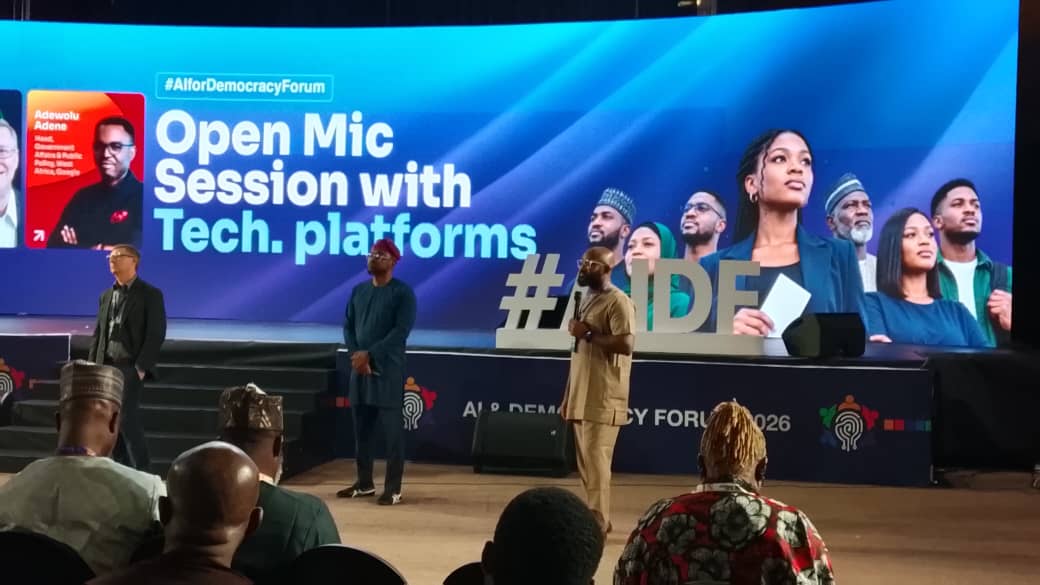
They disclosed this during an Open Mic session with technology platforms at the AI and Democracy Forum 2026, held in Abuja on Thursday, October 15.
Speaking at the session, Dave Leitchman, Senior Director of Global Elections at Microsoft, said the company monitors cybersecurity threats and disinformation as part of its broader information-integrity efforts.
Leitchman explained that Microsoft’s threat intelligence and threat analysis centres work with civil society organisations to track misleading narratives, particularly those linked to foreign state actors, and prevent harmful content from gaining prominence across its search engine and artificial intelligence platforms.
He said the company also prioritises authoritative election information to help voters access accurate details about when, where and how to vote.
According to him, the Independent National Electoral Commission (INEC) remains the authoritative source of information on Nigeria’s electoral processes, adding that Microsoft would proactively promote verified information from the commission.
“INEC is the authoritative source for elections information. You need to know when, where and how to vote. INEC is the source,” Leitchman said.
He explained that the approach involves reducing the visibility of known harmful misinformation narratives while ensuring that credible electoral information is more accessible to users.
On the handling of misleading artificial intelligence-generated content, Leitchman said Microsoft maintains reporting mechanisms through which users can flag deceptive election information and the unauthorised use of political candidates’ likenesses.
He noted that Microsoft, Google and 24 other technology companies signed the Tech Accord to Combat Deceptive Use of AI in Elections in 2024.
Although the accord formally expired at the end of that year, he said Microsoft had continued to maintain its commitments to addressing election-related deception across its products.
Leitchman added that Microsoft reviews user reports and takes appropriate action, which could include removing content or restricting its visibility, depending on the nature of the violation.
He also urged users to report inaccurate responses from AI chatbots, explaining that Microsoft’s Copilot includes a feedback mechanism through which reported political misinformation can be reviewed and corrected.
According to him, such reports feed into an internal process designed to identify errors and improve the accuracy of the platform’s responses.
He further clarified that Microsoft, TikTok and Snap do not permit political advertising, noting that advertising practices and user-data privacy remain important considerations in discussions about elections and technology.
However, Leitchman cautioned against treating artificial intelligence as a single, uniform technology, arguing that the term covers different applications, including chatbots, image generation, administrative tools and information-processing systems.
He said public communication about AI should be more precise to avoid creating unnecessary fear about its use in electoral processes.
“If we’re just doing optical character recognition on forms, we should say that. We shouldn’t say we’re using AI. We should say we’re digitising forms,” he said.
Also speaking, Adewolu Adene, Head of Government Affairs and Public Policy for West Africa at Google, said the company employs a combination of user reporting mechanisms and dedicated channels for law enforcement to address harmful content on its platforms.
Adene explained that law enforcement agencies could report suspicious patterns involving particular accounts or channels for review and possible action.
He added that ordinary users also have the power to flag content they consider abusive, aggressive or misleading, although a report does not automatically result in immediate removal.
According to him, the outcome of a review could range from removing specific content to restricting access to a channel or reducing the visibility of material that violates platform policies.
On civil society participation, Adene said Google’s approach involves building networks of local organisations, academics, researchers, community leaders and media practitioners rather than relying exclusively on individual civil society organisations.
He cited an initiative in Kaduna in which Google worked with an AI-focused civil society organisation to develop Hausa-language learning materials using animation, supported by contributions from community stakeholders and researchers.
Adene said the model demonstrated the importance of combining technology with local knowledge to make information more accessible and relevant to communities.
Addressing data protection concerns, he said Google applies security measures, permission controls and access restrictions across its products and services.
He urged users to understand the permissions they grant to digital platforms and said compliance with applicable data-protection regulations, including Nigeria’s data-protection framework, remained important to maintaining public confidence.
In his concluding remarks, Adene stressed that technology should be understood as a tool whose impact depends largely on how people choose to use it.
He urged voters, electoral authorities and law enforcement agencies to exercise personal responsibility and critical judgment when engaging with digital content, particularly during election periods.
According to him, while technology offers powerful capabilities, human agency remains essential in determining whether those capabilities are used to support informed choices or cause harm.
The session was moderated by Sam Itodo, Executive Director of Yiaga Africa, which convened the forum with its partners to examine the implications of artificial intelligence for democratic governance and electoral integrity.
The discussions highlighted the growing importance of collaboration among technology companies, election authorities, civil society organisations, law enforcement agencies and voters in tackling disinformation and safeguarding credible electoral processes ahead of Nigeria’s 2027 general elections.