By| Goodluck E.Adubazi, Abuja
Prominent human rights lawyer and Senior Advocate of Nigeria (SAN), Mr. Femi Falana, has raised concerns over what he described as the erosion of free speech in Nigeria, warning that citizens are increasingly being arrested and prosecuted for expressing opinions critical of those in power.
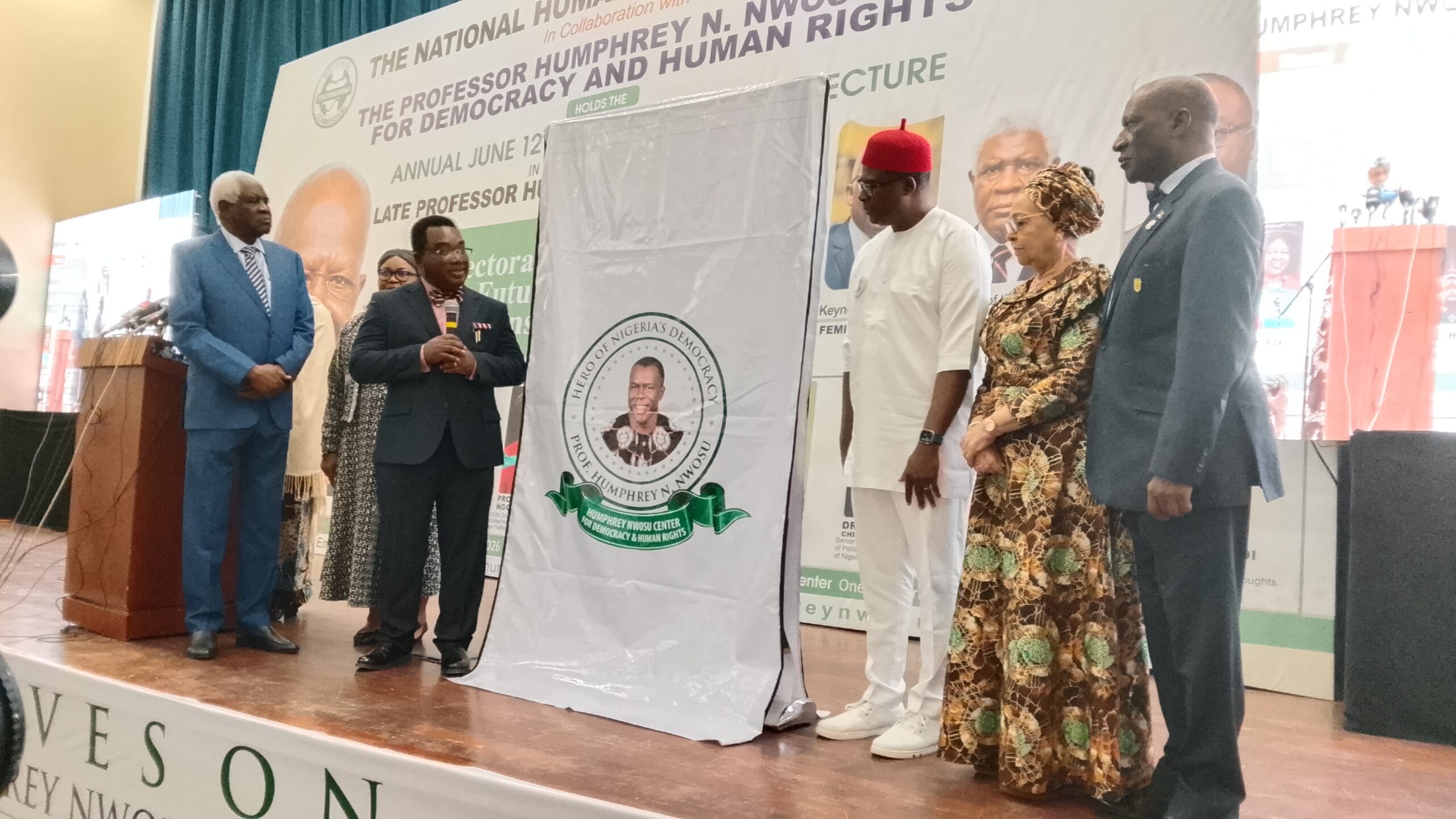
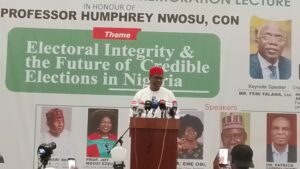
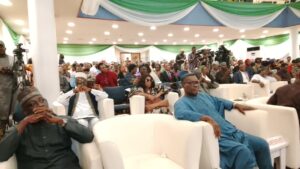
Falana made the remarks on Tuesday in Abuja during the unveiling of the Professor Humphrey N. Nwosu Centre for Democracy and Human Rights, established in collaboration with the National Human Rights Commission (NHRC) as part of activities marking the annual June 12 Democracy Day commemoration lecture.
The event was held in honour of the late Professor Humphrey Nwosu, CON, under the theme: “Electoral Integrity and the Future of Credible Elections in Nigeria.”
Speaking to participants, Falana lamented what he described as the growing use of the Cybercrimes Act to suppress dissenting voices.
“Today in Nigeria, if you make any statement against a governor, the president, or any influential person, you are charged under the Cybercrimes Act. Our right to free speech is already being taken away,” he said.
The senior lawyer recalled the landmark Arthur Nwankwo v. The State judgment, in which the Court of Appeal declared that colonial-era sedition laws should no longer be used to intimidate Nigerians.
According to him, public officials who feel defamed should seek redress through civil libel actions rather than deploying state institutions against critics.
Falana also recounted his own experiences of detention during military rule, noting that unlawful arrests and prolonged detentions remain prevalent despite Nigeria’s democratic status.
Security Challenges Threaten Democracy
The legal activist warned that worsening insecurity, kidnappings and terrorist activities pose a serious threat to democratic participation and future elections.
He expressed concern over the increasing number of schoolchildren and teachers held captive by criminal groups, stressing that no democracy can flourish where citizens live in fear.
“If terrorism and abductions continue unchecked, it will become difficult to conduct meaningful political campaigns and elections,” Falana stated.
He urged the Federal Government to provide better equipment and motivation for the Armed Forces, noting that Nigerian military personnel have demonstrated professionalism in numerous international peacekeeping missions.
Condemns Negotiations with Terrorists
Falana strongly condemned the practice of negotiating with terrorists and criminal groups, insisting that such actions embolden criminality and undermine the rule of law.
According to him, the provisions of Nigeria’s Terrorism Prevention and Prohibition Act prescribe severe penalties for engaging with terrorist groups.
“This business of negotiating with criminals and describing them as repentant is unacceptable. People who have killed innocent citizens, abducted children and collected ransom should be prosecuted in accordance with the law,” he said.
While commending recent security operations that led to the rescue of kidnapped victims, Falana emphasized that paying ransom and accommodating criminal elements only fuels further insecurity.
Calls for Accountability and Good Governance
Falana criticized political leaders for focusing on ethnic and religious divisions instead of addressing pressing national issues such as insecurity, unemployment, poverty, healthcare, education and infrastructure.
He called on citizens and the media to demand greater transparency from public office holders, particularly regarding the allocation and utilization of public funds across all levels of government.
“People should ask politicians what they have done about electricity, roads, healthcare and poverty. Those are the questions that matter,” he said.
The human rights advocate further urged governments to fully implement existing laws on social welfare, compulsory education and universal health insurance to improve the lives of vulnerable Nigerians.
Falana Advocates Greater Representation for Women
A significant part of Falana’s address focused on the underrepresentation of women in Nigerian politics.
He described Nigeria as lagging behind several African countries in gender inclusion despite women constituting more than half of the nation’s population.
Citing examples from countries such as Namibia, Rwanda, South Africa and Ethiopia, Falana noted that women occupy top political offices and hold substantial representation in government.
“You cannot have democracy without the liberation and inclusion of women. Excluding women from political participation weakens democracy itself,” he said.
He questioned why Nigerian women continue to be marginalized in elective and appointive positions and called for deliberate measures to increase their participation in governance.
NHRC Reaffirms Commitment to
Democracy and Human Rights
Earlier, the Executive Secretary and Chief Executive Officer of the National Human Rights Commission, Dr. Tony Ojukwu, OFR, SAN, reaffirmed the Commission’s commitment to promoting, protecting and enforcing human rights in Nigeria.
Ojukwu described democracy and human rights as inseparable, emphasizing that credible elections, civic participation, freedom of expression, equality before the law and accountable governance remain essential pillars of democratic development.
He said the newly established Professor Humphrey N. Nwosu Centre for Democracy and Human Rights would focus on civic education, electoral reform advocacy, leadership development, youth engagement, research and the promotion of ethical governance.
“The Centre provides a valuable platform for sustained national engagement on democratic consolidation and human rights advancement,” he stated.
Nwosu Family Unveils Centre to Preserve Democratic Legacy
Speaking on behalf of the Nwosu family, Engr. Nnaemeka Humphrey Nwosu, Co-founder and President of the Humphrey N. Nwosu Centre, said the institution was created to preserve and advance the democratic ideals championed by his late father.
He recalled the historic June 12, 1993 presidential election, widely regarded as Nigeria’s freest and fairest poll, describing it as a defining moment that united Nigerians across ethnic and religious lines.
“The June 12 election was more than an election; it was a moment of hope and national unity,” he said.
According to him, although the election was annulled, it ignited a democratic consciousness among Nigerians and reinforced the belief that democracy is worth defending.
He said the new Centre would serve as a platform for promoting integrity, transparency, courage, credible elections and respect for human rights across Nigeria and Africa.
“The Centre is more than a tribute to one individual. It is a promise that the values my father stood for will not only be remembered but actively practiced,” Nwosu added.
A Renewed Call for Democratic Reform
The unveiling of the Professor Humphrey N. Nwosu Centre concluded with renewed calls for electoral integrity, stronger protection of civil liberties, improved security, greater government accountability and increased participation of women in politics as Nigeria prepares for future democratic milestones.