
By| Goodluck E.Adubazi, Abuja
The Federal Government has reaffirmed its commitment to ensuring that data, research and credible evidence become the foundation of policymaking and programme implementation, as the Federal Ministry of Women Affairs and Social Development strengthened collaboration with Innovation for Poverty Action (IPA) to improve evidence-based interventions for women, children, families and vulnerable groups across Nigeria.
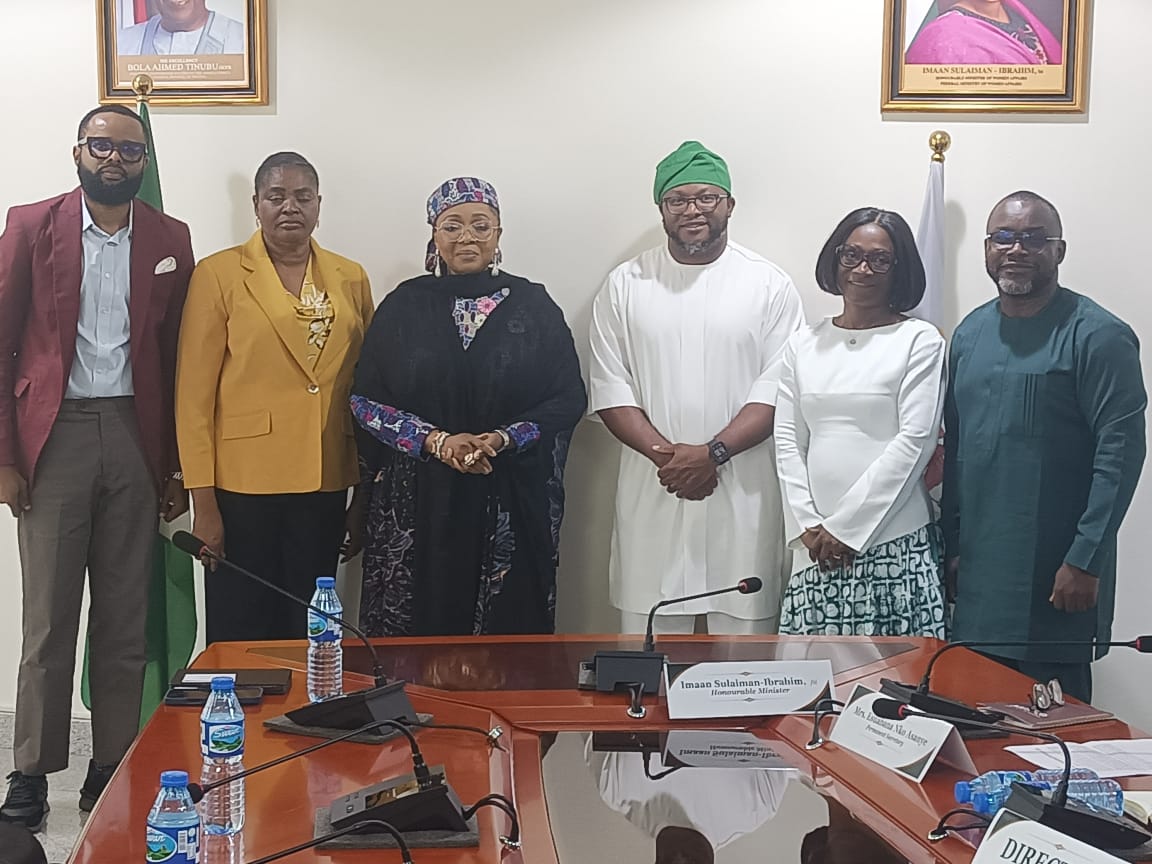
The Honourable Minister of Women Affairs and Social Development, Hajiya Imaan Sulaiman-Ibrahim, made this known while receiving the Regional Director for West Africa of Innovation for Poverty Action (IPA), Mr. Emeka Eluemunor, during a courtesy visit to her office in Abuja.
The Minister said the Renewed Hope Agenda of President Bola Ahmed Tinubu is anchored on measurable results, accountability and impactful service delivery, stressing that reliable data remains the bedrock of effective governance.
According to her, while government is prepared to take bold decisions to address national development challenges, such decisions must be guided by credible evidence, sound research and accurate data that reflect realities at the grassroots.
“Government is ready to act. Our responsibility is to ensure that those actions are guided by credible evidence and supported by quality research. Data must move beyond figures on paper to becoming the basis for decisions that improve the lives of our people,” she said.
Imaan identified fragmented reporting as one of the major challenges confronting public institutions, noting that it often fails to capture the true impact of government programmes despite measurable achievements.
She explained that several advocacy and empowerment initiatives have delivered positive outcomes that were not adequately reflected because available data had not been properly analysed or linked to policy results.
“Sometimes we are achieving results, yet our reports fail to tell the complete story because we are not connecting the dots. We need credible data that provides clear evidence of impact, strengthens accountability and inspires better policymaking,” the Minister stated.
She emphasized that evidence-based governance requires robust monitoring, evaluation, learning and adaptive management systems capable of generating practical knowledge for continuous improvement.
The Minister disclosed that the Ministry is strengthening its capacity in data collection, research, analysis and reporting to ensure that programmes targeting women, children and families produce measurable outcomes.
“Learning, adapting and reporting all require quality evidence. But beyond reporting, what matters most is how we use what we have learned to make better decisions. Evidence must influence policy, strengthen implementation and improve service delivery,” she added.
Imaan further noted that credible national statistics play a critical role in attracting government attention and mobilising greater investment in key sectors. She cited data highlighting Nigeria’s large child population and the growing needs of women and families as evidence supporting sustained government interventions and institutional support.
She assured the IPA delegation of the Ministry’s readiness to provide an enabling environment for technical collaboration, urging the organisation to become a strategic partner in strengthening evidence-based governance.
“Please see yourselves as part of this Ministry. The work we are doing is too important for us to work in isolation. Together, we can build stronger institutions, strengthen technical capacity and ensure that evidence consistently drives national development decisions,” she said.

Earlier, the Regional Director for West Africa, Innovation for Poverty Action, Mr. Emeka Eluemunor, commended the Minister for her commitment to evidence-based leadership and institutional reforms.
He observed that effective policymaking depends on credible data, continuous learning, rigorous research and strong technical capacity, assuring the Ministry of IPA’s readiness to support efforts aimed at strengthening monitoring and evaluation, data systems, policy analysis and institutional capacity development.
According to him, quality evidence enables governments not only to measure progress but also to understand why programmes succeed or fail, thereby improving future interventions and maximising development outcomes.
Eluemunor reaffirmed IPA’s commitment to partnering with the Ministry in building sustainable systems that will promote research-driven policymaking and enhance the effectiveness of programmes targeting women, children, families and vulnerable populations.
“Ahmed Lawan Danbazau, MNIPR ,Head, Press and Public Relations Department Federal Ministry of Women Affairs and Social Development, In a statement noted.