By| Goodluck E.Adubazi, Abuja
The Honourable Minister of Women Affairs and Social Development, Hajiya Imaan Sulaiman-Ibrahim, has reaffirmed the Federal Government’s commitment to deepening collaboration with the National Identity Management Commission (NIMC) to accelerate digital identity registration for women, children and vulnerable groups across Nigeria.
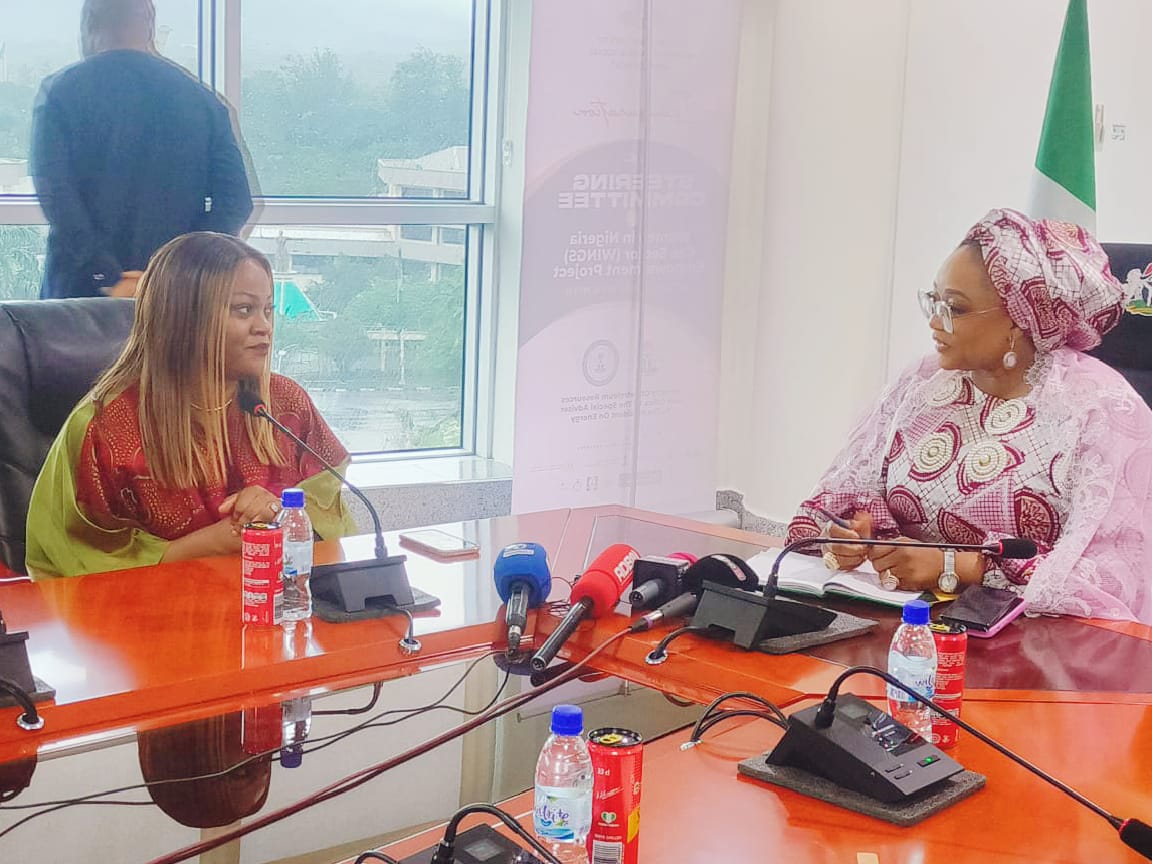
The Minister gave the assurance during a courtesy visit by the Director-General and Chief Executive Officer of NIMC, Engr. (Dr.) Abisoye Coker-Odusote, and her management team to the Ministry’s headquarters in Abuja.
Speaking during the meeting, Hajiya Imaan Sulaiman-Ibrahim described Nigeria’s newly enacted identity management framework as a landmark reform that aligns with President Bola Ahmed Tinubu’s Renewed Hope Agenda and supports ongoing reforms across key sectors of the economy.
She emphasized that a reliable national identity system is critical for effective social protection programmes, financial inclusion, digital commerce and ensuring government interventions reach their intended beneficiaries.
The Minister noted that women make up the largest proportion of Small and Medium Enterprises (SMEs) in Nigeria and increasingly depend on digital platforms for business transactions.
According to her, strengthening identity management will provide greater protection for women conducting business online while enhancing trust in the country’s digital economy.
She also stressed that robust identity management would play a pivotal role in the successful implementation of the Federal Government’s Universal Child Grant initiative by promoting transparency, preventing abuse and ensuring that every eligible Nigerian child benefits from the programme.
Highlighting the achievements of the Nigeria for Women Project Scale-Up, the Minister said the initiative has continued to empower women through self-help groups, improved savings culture and expanded access to financial services.
She maintained that increased identity registration remains essential to unlocking financing opportunities and wider government support for women.
“Every woman deserves an identity that opens doors to opportunities, financial services and social protection. Our vision is to ensure that no woman or child is left behind,” she stated.
The Minister further commended NIMC’s drive to establish a single identity number throughout every Nigerian’s lifetime, describing the initiative as transformative for healthcare, education, social welfare and access to public services.
She also called for stronger collaboration between both institutions in addressing Gender-Based Violence (GBV), noting that integrated identity systems and quality national data would improve planning, accountability and the protection of survivors.
Earlier, the Director-General of NIMC, Engr. (Dr.) Abisoye Coker-Odusote, said the Commission has evolved into Nigeria’s foundational identity authority and the backbone of the country’s Digital Public Infrastructure.
She explained that the new legal framework has strengthened the Commission’s capacity to combat identity fraud while enabling seamless delivery of digital services through interoperable government databases.
According to her, NIMC is implementing the “One Identity for All” initiative to simplify access to public services by eliminating repetitive data collection and providing secure digital authentication.
“We are harmonising government databases so that every Nigerian can rely on one trusted identity for accessing services seamlessly, securely and efficiently,” she said.
The NIMC Director-General also disclosed that the Commission has introduced digital credentials, electronic signatures, digital certificates and free electronic identity cards through its enhanced digital identity application.
She revealed that NIMC has commenced ward-level enrolment nationwide on the directive of President Bola Ahmed Tinubu to ensure inclusive identity registration, particularly in underserved communities.
“Our ambition is to ensure that every Nigerian woman is captured in the national identity database before the end of the year. Achieving this requires strong collaboration with the Federal Ministry of Women Affairs and Social Development,” Coker-Odusote stated.
Ahmed Lawan Danbazau,Head, Press and Public Relations Department Federal Ministry of Women Affairs and Social Development in a statement said ” The meeting reaffirmed the shared commitment of both institutions to leveraging digital identity as a catalyst for improved governance, social protection, financial inclusion and sustainable national development.