
• Jingir’s Remarks ‘Highly Provocative’, Dangerous — FFK Warns
By| Goodluck E.Adubazi, Abuja
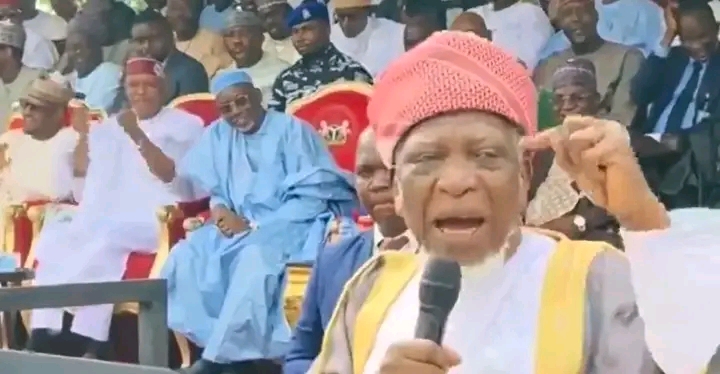
The controversy over the Muslim-Muslim presidential ticket has resurfaced ahead of the 2027 general elections, following a call by Islamic cleric, Sheikh Yahya Jingir, for Muslims to continue supporting the political arrangement.
Jingir, in a video circulating on social media on Sunday, urged Muslims to unite behind Muslim-Muslim candidates, while praising President Bola Ahmed Tinubu for championing the arrangement during the 2023 presidential election.
The cleric made the remarks at an event attended by some All Progressives Congress governors, including Kano State Governor Abba Yusuf and his Jigawa State counterpart, Umar Namadi.
“Special thanks to my political hero, Bola Tinubu, who raised the flag of this political ideology, describing it as a purely Muslim-Muslim coalition,” Jingir said.
“I am among the staunch advocates of the Muslim-Muslim ticket, and I call on you to come together for Muslim-Muslim ticket.”
Jingir acknowledged that the arrangement had generated opposition among Christians and members of other faiths but insisted that he had committed no wrongdoing by advocating a Muslim-Muslim ticket.
He declared: “But as a Muslim, I repeat it, Muslim-Muslim! No going back on this.”
The cleric also urged his audience to obtain their Permanent Voter Cards ahead of the elections, while making remarks about the relative population of Muslims and Christians in Nigeria.
He further attributed the electoral defeat of opponents of the Muslim-Muslim ticket in 2023 to his advocacy for the arrangement and declared his support for Muslim-Muslim candidates in 2027.
“Therefore my vote is for a Muslim-Muslim candidate! What about you, the Muslim umma?” he asked.
Reacting to the development, Nigeria’s Ambassador-designate to South Africa, Femi Fani-Kayode, described Jingir’s comments as “highly provocative” and cautioned against rhetoric capable of deepening religious divisions.
Fani-Kayode, in a post on X on Sunday, said he respected the cleric but disagreed with what he described as extremist rhetoric.
“I have immense respect for Sheikh Jingir but I am constrained to point out that the extremist rhetoric he has indulged in here is most unhelpful and neither is it true,” he said.
“Worse of all is the fact that it is highly provocative. Kindly take note that it is a very slippery and dangerous slope to take and is best avoided.”
Fani-Kayode stressed that Nigeria was neither a Muslim nor Christian country, describing the nation as a secular and multi-religious state.
“Nigeria is NOT a Muslim country and neither is she a Christian country. She is a SECULAR and MULTI-RELIGIOUS state comprising of BOTH Christians and Muslims in equal numbers and that is our strength,” he said.
The former minister said his support for a Muslim-Muslim ticket in 2027 was based on the competence, character and electoral strength of the candidates, rather than their religious identity.
“We are supporting a Muslim/Muslim ticket for 2027, as we did in 2023, only because of the calibre, ability, sincerity of purpose, character, utility and electoral strength of our Presidential and Vice Presidential candidates and their ability to deliver and not because they are Muslims,” he stated.
He warned that religion should not be allowed to divide Nigerians, arguing that the country’s political discourse should focus on policies, competence and the personalities of candidates.
“We must not allow this issue to divide our ranks. We are NIGERIANS before being Christian or Muslim and we must not only stand as ONE but also go to the polls as ONE,” Fani-Kayode added.
Jingir’s comments have generated mixed reactions on social media, with some Nigerians describing the remarks as divisive and inappropriate in a multi-religious country.
Others, however, defended the political viability of a Muslim-Muslim ticket, arguing that every Nigerian, irrespective of religion, has the constitutional right to seek the presidency.
One X user, identified as @Abdulrasheed_SB, said religious affiliation should not determine who could aspire to political office.
“Christian or Muslim, every Nigerian has the right to aspire to the presidency. No religion owns Nigeria.
Religious bigotry has no place in our democracy—equal rights, equal opportunity, one Nigeria,” the user wrote.
Another user, @Sheff4real, argued that while the arrangement might not be suitable for every part of the country, “that’s the way to go in the North.”
The latest controversy is expected to further intensify debate over the place of religion, political representation and national unity as political parties and prospective candidates prepare for the 2027 elections.