
By | Goodluck E.Adubazi, Abuja
President and Chairman of the Board of Directors of the African Export-Import Bank (Afreximbank), George Elombi, has called on African leaders to collectively defend and strengthen the continent’s financial institutions, saying Africa must have the capacity to finance its own development without seeking permission from external powers.
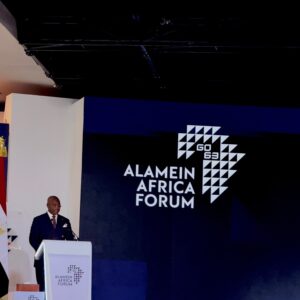
Elombi made the call on Saturday at the opening ceremony of the Alamein Africa Forum 2026 in New Alamein, Egypt, where he urged African heads of state and governments to treat institutions such as Afreximbank as assets they own and must actively protect.
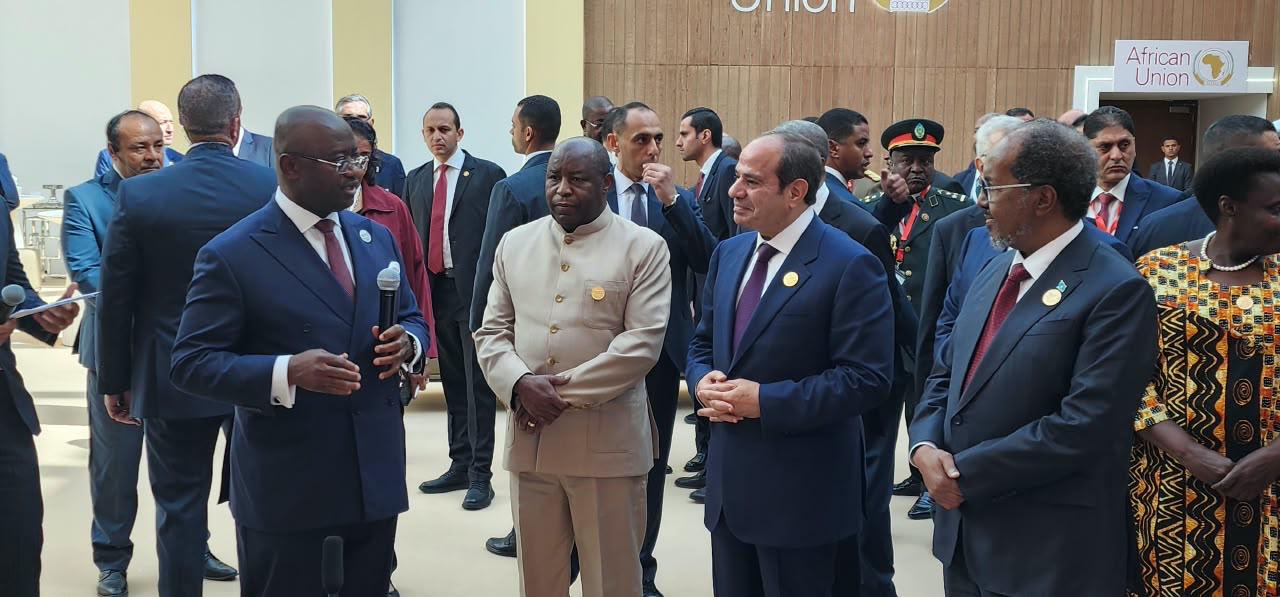
Addressing Egyptian President Abdel Fattah El-Sisi and other African leaders at the forum, Elombi said the transformation of Alamein from a historic battlefield into a venue where Africans deliberate on their future was symbolic of the continent’s growing determination to shape its own destiny.
He recalled Egypt’s longstanding support for Afreximbank, noting that the country signed the agreement providing the Bank with a home on August 31, 1994, barely a year after its establishment.
According to him, Cairo has remained the Bank’s home for more than three decades, while Egypt also hosted the first Intra-African Trade Fair and again offered to host the event in 2023 when the Bank was unable to secure another host.
He thanked the Egyptian government for its continued support, including hosting Afreximbank’s new global headquarters in the New Administrative Capital.
Elombi said Afreximbank was proud to partner with Egypt’s Ministry of Foreign Affairs and the African Union Development Agency (AUDA-NEPAD) in convening the forum, stressing the importance of economic diplomacy in promoting peace and security across Africa.
The Afreximbank president traced the institution’s origins to the African debt crisis of the early 1990s, when African countries faced severe financial pressures and declining access to international trade finance.
He said African governments responded by creating a bank “owned by Africans, governed by Africans and answerable to Africans.”
“You did not wait for permission. You did not wait for someone else to believe in the idea. You built it yourselves,” Elombi told the African leaders.
He said Afreximbank’s history of responding to crises was rooted in its mandate, adding that the institution had repeatedly intervened when African economies faced severe economic shocks.
According to him, following disruptions to shipping lanes, fuel markets and fertiliser supplies in February 2026, the Bank’s Board approved a $10 billion Gulf Crisis programme within weeks.
He also cited Afreximbank’s interventions during the COVID-19 pandemic and the Russia-Ukraine war, including a $4 billion programme deployed after the war triggered major food and energy price increases.
“When Africa needs its bank, its bank must be there,” he said.
Elombi also highlighted the financial growth of Afreximbank, saying shareholders’ funds had risen to almost $9 billion, while net income increased by 30 per cent in the first half of 2026.
He said the Bank’s balance sheet was now about six times larger than it was a decade ago.
He attributed the growth to successive capital increases by African shareholders, saying almost $300 million in fresh equity was provided in cash in 2025, while shareholders had paid another $226 million so far in 2026, with a further $300 million expected.
Elombi argued that the contributions demonstrated the tangible commitment of African governments to the institution and should be recognised in international assessments of its financial strength.
The Afreximbank chief criticised what he described as international financial assessment frameworks that place greater value on callable capital and highly rated sovereign shareholders than on capital actually paid into African institutions.
He questioned the weight given to callable capital, noting that such commitments had historically remained largely promises that had not been called upon during major global crises.
“Who would answer it?” he asked, questioning what would happen if callable capital were demanded during a crisis.
By contrast, he said African governments had repeatedly provided Afreximbank with actual cash contributions, even when their own budgets were under pressure.
“We are not an incomplete copy of the Bretton Woods institutions,” Elombi said. “We are an institution built from a different history, with a different ownership model and a different record.”
He argued that credit ratings should reflect the substance and performance of institutions rather than their conformity with traditional models.
Elombi also referred to Afreximbank’s support for Ghana during the country’s economic crisis, saying the Bank continued providing financing when other institutions had reduced their exposure.
He said Afreximbank’s intervention was consistent with its mandate as an African-owned and African-controlled institution.
Elombi said the Bank subsequently faced criticism over its treatment during Ghana’s debt restructuring, arguing that its rating should not be determined by its decision to support an African country during a period of severe financial distress.
He maintained that Afreximbank’s willingness to intervene demonstrated its relevance to African economies.
“The pressure on this institution is not a sign of weakness. It is proof of relevance,” he said.
The Afreximbank president urged African governments to take three key steps to protect the continent’s financial institutions.
First, he called on them to continue capitalising African institutions, saying every financial contribution demonstrates ownership and commitment.
Second, he urged governments to defend the legal commitments contained in the treaties establishing African multilateral institutions, particularly Afreximbank’s preferred creditor status.
Third, he called for greater unity among African multilateral financial institutions, saying the continent must respond collectively whenever one of its institutions comes under pressure.“A challenge to one is a test of all,” he said.
Elombi said Africa’s ambitions must extend beyond defending existing institutions to creating a stronger continental financial architecture capable of mobilising African savings, financing trade, supporting businesses and investing in infrastructure.
He argued that a continent of about 1.5 billion people could not indefinitely depend on financial systems designed elsewhere and decades ago to determine the value and financing capacity of African economies.
“We are not seeking to replace the global system,” he said. “Rather, we are insisting on a place within it that reflects our weight, our capital, our markets and our ambitions.”
He concluded by urging African leaders to demonstrate the same determination that led to the creation of Afreximbank more than three decades ago.
“Thirty-three years ago, you were told you were not capable. You built this Bank anyway,” Elombi said.“When the world retreats, Africa must not.”
He added: “This Bank is yours. Defend it as you built it — without asking for anyone’s permission.”