By| Goodluck E.Adubazi, Abuja
Nigeria’s defence and security budget rose sharply from N1.5 trillion in 2021 to N6.8 trillion in 2025, reflecting the growing financial burden of combating terrorism, experts disclosed on Tuesday as African stakeholders gathered in Abuja to strengthen efforts against terrorism financing.


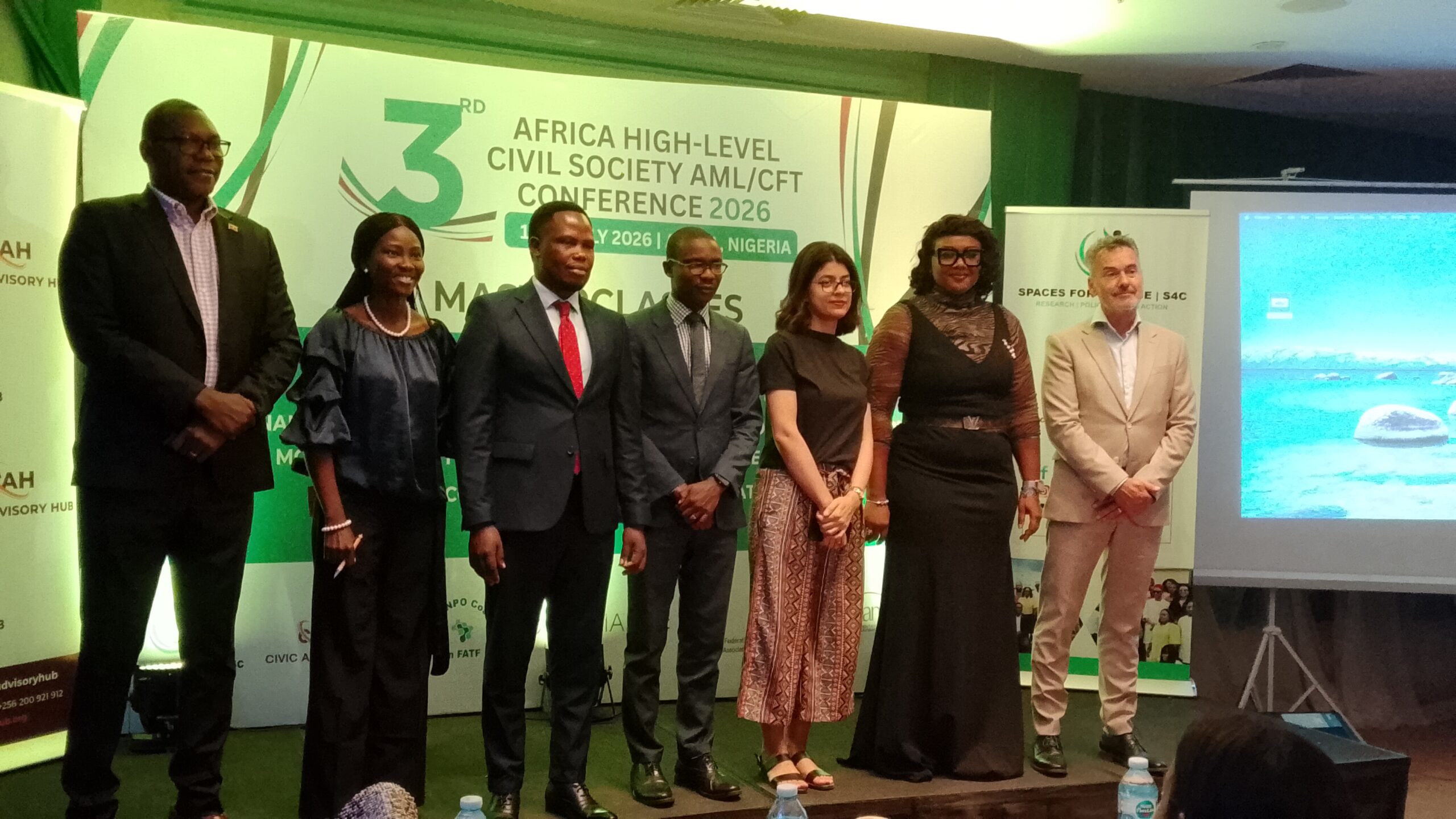
The disclosure was made at the opening of the 3rd Africa High-Level Civil Society Anti-Money Laundering/Counter Financing of Terrorism (AML/CFT) Conference held on Tuesday at the Abuja Continental Hotel, organised by Spaces for Change (S4C).


The conference attracted participants from Uganda, Ghana, South Africa, Mozambique, Tanzania, Zambia and several other African countries, alongside representatives of the Economic and Financial Crimes Commission (EFCC), ECOWAS, the Special Control Unit Against Money Laundering (SCUML), Civic Advisory Hub, Ford Foundation, Human Security Collective and other stakeholders.
Speaking during a pre-conference masterclass on Financial Action Task Force (FATF) Recommendation 8, Technical Assistant to the Director of SCUML, Temitope Erinomo, said the increasing cost of terrorism has placed enormous pressure on Nigeria’s economy and public finances.
According to him, terrorism has evolved beyond ideological motivations into organised criminal enterprises driven by illegal mining, cross-border criminal networks and exploitation of informal financial systems.
He explained that terrorist groups now exploit cash-based economies, informal money transfer systems and emerging technologies, including cryptocurrencies, making the tracking of illicit financial flows increasingly difficult.
Erinomo noted that terrorism has expanded beyond the North-East to other parts of the country, with new extremist groups emerging and collaborating across West Africa.
He said the rising security threats have forced government to significantly increase spending on defence at the expense of critical sectors such as education, healthcare, infrastructure and social investments.
According to him, beyond the destruction of lives and infrastructure, terrorism has displaced farming communities, worsened humanitarian crises and created millions of internally displaced persons, thereby affecting food production and economic growth.
He stressed that stronger collaboration between governments, regulators and non-profit organisations (NPOs) is necessary to prevent the abuse of charitable organisations for terrorist financing.
Executive Director of Spaces for Change, Victoria Ibezim-Ohaeri, said the implementation of FATF Recommendation 8 must strike a balance between protecting national security and safeguarding the legitimate work of civil society organisations.
She noted that while non-profit organisations could be exploited by criminal elements, governments must avoid regulations that unnecessarily restrict genuine humanitarian and development activities.
According to her, countries should adopt evidence-based, proportionate and risk-based regulatory measures rather than imposing blanket restrictions on the entire civil society sector.
She explained that FATF Recommendation 8 encourages countries to identify only those categories of non-profit organisations that are genuinely vulnerable to terrorist financing while protecting legitimate organisations from undue interference.
Ibezim-Ohaeri added that understanding the size, operational structure, funding sources and geographical spread of non-profit organisations is critical to effective risk assessment.

She also traced the evolution of FATF Recommendation 8, noting that earlier assumptions portraying all non-profit organisations as highly vulnerable to terrorist financing had since been revised in favour of a more balanced, risk-based approach.
The conference featured awards and panel discussions involving regulators from Nigeria, Ghana and The Gambia on compliance with FATF standards, while financial sector experts from Nigeria and South Africa examined financial inclusion, compliance challenges and risk management within the non-profit sector.

Other sessions focused on evaluating African countries’ compliance with FATF Recommendation 8, with legal experts from the Inter-Governmental Action Group Against Money Laundering in West Africa (GIABA) and the Eastern and Southern Africa Anti-Money Laundering Group (ESAAMLG) sharing regional experiences and best practices.
Participants from Uganda, the Netherlands and Asia also urged African non-profit organisations to become active partners in developing sustainable solutions to terrorism financing across the continent.
The conference continues with technical sessions, stakeholder engagements and cultural performances aimed at strengthening cooperation between governments, financial institutions and civil society in the fight against terrorism financing across Africa.