
By| Goodluck E. Adubazi, Abuja
The Minister of Innovation, Science and Technology, Dr. Kingsley Tochukwu Udeh, has said Nigeria will use the forthcoming Africa Raw Materials Summit 2026 to showcase its progress in raw materials development, industrialisation and research commercialisation, while rallying African countries to move from exporting raw commodities to producing finished goods.

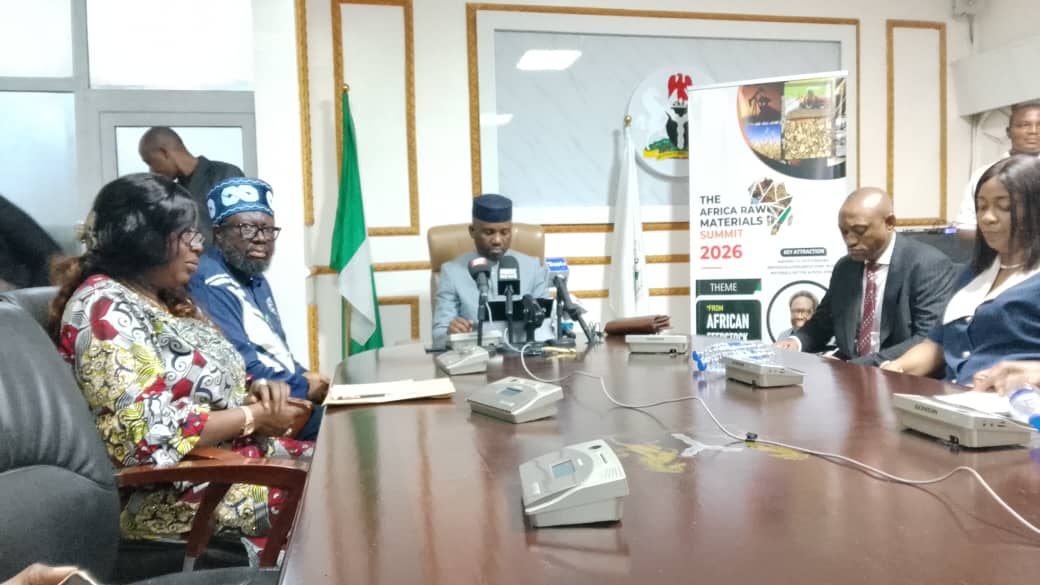
Udeh spoke on Thursday, October 15, 2026, during a ministerial media parley organised by the Raw Materials Research and Development Council (RMRDC) at its boardroom in Abuja, ahead of the summit scheduled for October 19 and 20.
The minister said the summit would bring together ministers responsible for science, technology, innovation, industry and raw materials, alongside researchers, investors, development partners and industry leaders from across Africa to address challenges affecting the continent’s raw materials value chain.
He explained that the gathering would provide a platform for collaboration, coordination, knowledge-sharing and the development of practical solutions to common challenges confronting the African innovation and raw materials ecosystem.
According to him, participants will review the outcomes of the maiden edition of the summit, assess progress made, identify outstanding gaps and develop strategies to address them.
Udeh said the meeting would also encourage what he described as positive peer pressure among African countries, allowing nations to learn from one another’s experiences and adapt successful policies and practices to their respective circumstances.
He added that a major objective of the summit was to secure collective action towards ensuring that Africa’s raw materials were processed and transformed into finished or semi-finished products before export, rather than being shipped out primarily as unprocessed commodities.
On Nigeria’s expected gains from hosting the summit, the minister said the country would have an opportunity to showcase its achievements, demonstrate its commitment to industrial development and share its experiences with other African nations.
He noted that Nigeria’s efforts to strengthen its raw materials sector, establish a legal framework for value addition and promote the commercialisation of research outcomes would form part of the country’s contributions to discussions at the continental gathering.
A major highlight of the minister’s remarks was the proposed amendment to the law establishing the RMRDC, which seeks to introduce a minimum 30 per cent value addition to Nigeria’s raw materials before they are exported.
Udeh disclosed that the proposed amendment had passed through the National Assembly and was undergoing further executive-level review to ensure alignment with the government’s industrialisation objectives.
He explained that the review process was intended to address areas requiring realignment before the amendment could proceed towards presidential assent.
The minister said the proposed legislation was designed to establish a framework for promoting local processing, encouraging investment in domestic industries and ensuring that more economic value was retained within Nigeria.
He stressed that the policy would require the development of the technical capacity, infrastructure and industrial ecosystem needed to process the country’s raw materials.
According to him, the RMRDC would play a critical role in identifying the potential uses of different raw materials and supporting the development of technologies and processes that could transform them into higher-value products.
He added that private-sector operators and industrial players would be expected to translate research findings and technical innovations into commercially viable products and businesses.
Udeh said the government was pursuing a combination of incentives and regulatory measures to encourage stakeholders to comply with the proposed value-addition framework.
He maintained that implementation would depend on effective collaboration among government agencies, researchers, investors and industry players.
The minister also identified the commercialisation of research outcomes as a critical component of Nigeria’s industrialisation strategy, warning that research would have limited economic impact if its findings were not translated into practical products, services and businesses.
He said the government was intensifying efforts to connect research institutions with industry, enabling manufacturers and investors to adopt locally developed technologies and expand domestic production.
Udeh argued that commercialisation and value addition could stimulate investment, encourage the establishment of factories and create employment opportunities across the country.
He expressed optimism that effective implementation of the proposed 30 per cent minimum value-addition policy, alongside stronger research commercialisation, could significantly improve industrial output and job creation.
The minister also highlighted the proposed National Research and Innovation Development Fund as another important measure intended to support research and innovation.
He said the fund, alongside the proposed RMRDC amendment, would strengthen the country’s capacity to develop homegrown solutions, promote industrialisation and reduce dependence on imported technologies.
Udeh emphasised that Nigeria needed to move beyond conducting research to ensuring that research findings generated measurable economic benefits.
He called for stronger partnerships between research institutions, universities, industrial research and development units, investors and private-sector businesses.
Summit Must Produce Measurable Results
Beyond the discussions and presentations expected at the summit, the minister called for a structured follow-up mechanism to ensure that commitments and recommendations were implemented.
He said the summit should not end with participants returning to their respective countries without a clear framework for tracking progress.
According to him, there should be a post-summit implementation programme, with periodic reviews to assess progress by participating countries and individual stakeholders.
He said such a mechanism would help identify implementation challenges, evaluate the effectiveness of agreed solutions and ensure that the summit produced sustainable results.
Udeh also stressed the importance of continuity, noting that the decision to organise a second edition of the summit provided an opportunity to build on the achievements and lessons of the maiden edition.
He said the forthcoming meeting would enable participants to examine what had worked, identify remaining gaps and agree on further steps to strengthen the continent’s raw materials ecosystem.
Science and Technology Central to Economic Growth
The minister said no country could attain advanced economic status without taking innovation, science and technology seriously.
He maintained that technological capacity was essential to economic independence, industrial development and sustainable growth.
According to him, Nigeria’s ambition to develop a knowledge-based economy and expand its gross domestic product towards the $1 trillion mark would require deliberate investment in research, innovation, technology transfer and local manufacturing.
He said President Bola Ahmed Tinubu’s leadership of the National Council on Science, Technology and Innovation demonstrated the importance the administration attached to the sector.
Udeh added that the government’s industrialisation agenda was focused not only on acquiring foreign technologies but also on building local capacity to manufacture and maintain them.
Using an example from his experience in Imo State, where he previously served as Attorney-General, the minister described efforts to encourage technology suppliers to establish local production or assembly facilities rather than merely supplying imported equipment.
He said such arrangements could create employment, strengthen technology transfer and develop the skills required for domestic manufacturing.
The minister also highlighted the government’s Youth and Students in Innovation initiative, which he said was intended to build the capacity of young Nigerians to develop and produce technologies, rather than remain solely consumers of imported innovations.
He argued that building a domestic technology ecosystem would require sustained investment in skills development, research, manufacturing and commercial partnerships.
Tinubu’s Reforms and Industrial Development
Udeh said the administration’s reforms were aimed at stimulating economic growth, creating jobs and improving the livelihoods of Nigerians.
He acknowledged that reforms required time to produce their full effects but maintained that continued implementation was necessary to achieve the government’s industrialisation objectives.
The minister urged stakeholders to support the completion of ongoing initiatives, including the proposed 30 per cent value-addition framework, the National Research and Innovation Development Fund and the intensified commercialisation of research outcomes.
He said the initiatives were interconnected and would help Nigeria build the capacity to process its resources, develop local industries and compete more effectively in international markets.
According to him, African countries could also benefit from sharing experiences and adopting practical strategies to strengthen their respective industrial sectors.

Earlier, the Director-General of the RMRDC, Prof. Nnayelugo M. Ike-Muonso, introduced the minister and welcomed members of the media to the engagement.
He said the summit would provide an opportunity for Nigeria and other African countries to discuss the development of raw materials and explore strategies for strengthening the continent’s industrial and innovation capabilities.
The Africa Raw Materials Summit 2026 is scheduled to hold in Abuja from October 19 to 20, with discussions expected to focus on collaboration, value addition, research commercialisation and the development of a stronger African raw materials value chain.