
By | Goodluck E. Adubazi, Abuja
Former Commonwealth Secretary-General, Chief Emeka Anyaoku, GCON, has said certificate forgery was virtually unknown during his generation, stressing the importance of character, hard work and service to society in building a respected name and effective leadership.
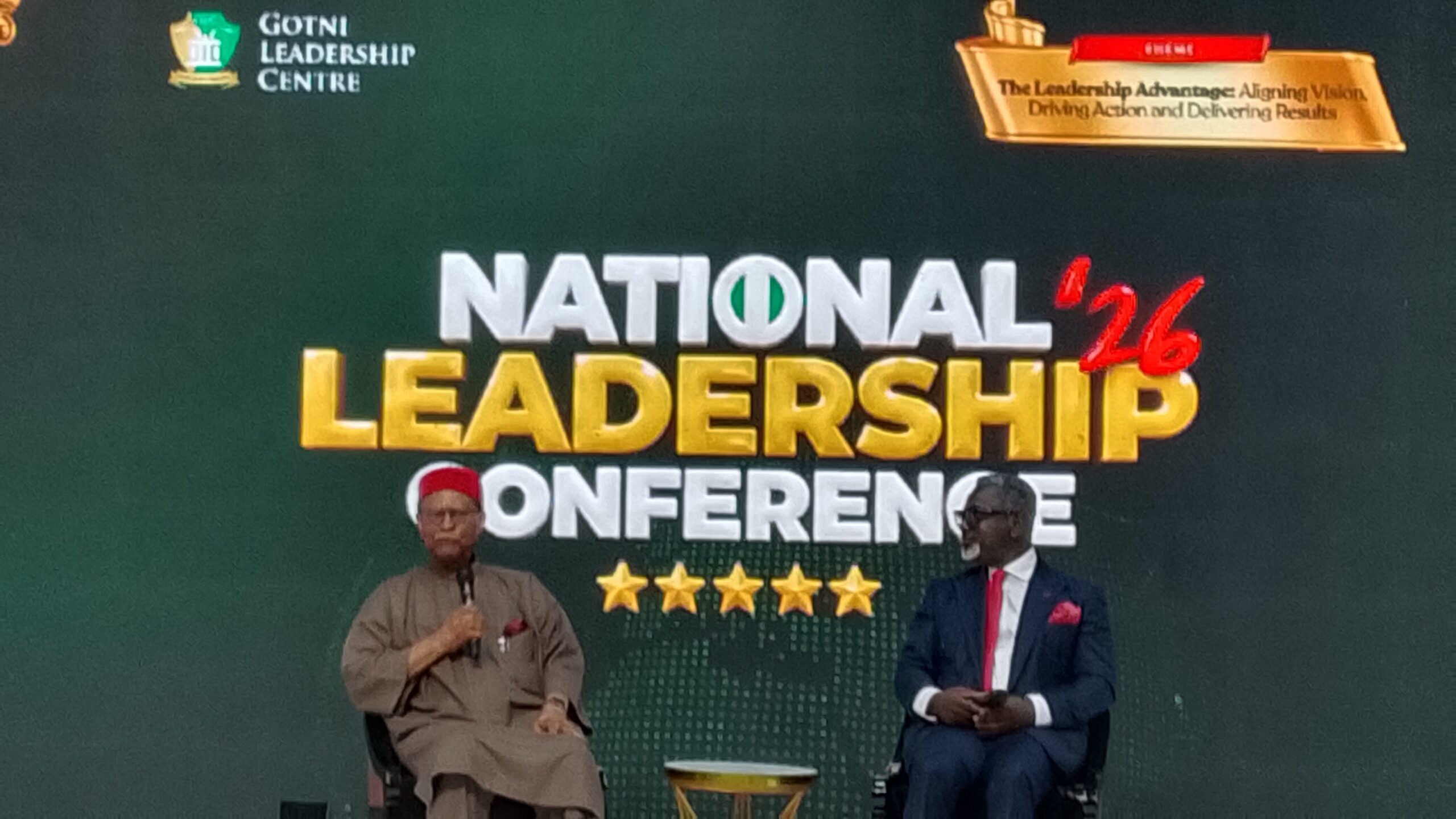
Anyaoku, who is also Chairman of the Governing Board of GOTNI Leadership University, spoke during a fireside chat on Day Two of the National Leadership Conference 2026, held at the Transcorp Hilton Hotel, Abuja.
The former Commonwealth Secretary-General, who reflected on his decades of service to Nigeria and the international community, described GOTNI Leadership University as “an idea whose time has come,” saying the institution could help address the shortage of effective leadership in Nigeria.
Anyaoku said he retired from the Commonwealth 26 years ago after serving for 10 years as Secretary-General, adding that his subsequent engagements included serving for 14 years as Chairman of Nigeria’s Presidential Advisory Council on Foreign Affairs.

He also recalled his service as International President of the World Wide Fund for Nature (WWF), following the late Prince Philip of the United Kingdom, as well as his eight-year tenure as a trustee of the British Museum under the late Queen Elizabeth II.
According to him, although he had largely retired from demanding public responsibilities, he accepted an invitation to become associated with GOTNI Leadership University after being approached to advise on the initiative.
“I could not resist his invitation. So I spoke and assumed the role of the chairman of the university,” Anyaoku said.
Reflecting on the meaning of leadership, Anyaoku cited the classical understanding of leadership and stressed that effective leaders must possess vision, build teams and inspire people rather than rely solely on authority.
He said a leader must have a clear vision of where he or she intends to take an institution or country, while also possessing the capacity to build and inspire a team to work harmoniously.
Anyaoku described the establishment of GOTNI Leadership University as significant, noting that institutions dedicated specifically to leadership development remain limited on the African continent.
He said the university’s focus on developing effective leaders was particularly important because of what he described as a shortage of leadership capacity in Nigeria, both in the public and private sectors.
The former Commonwealth Secretary-General also took participants through some of the major episodes of his international career, particularly his role in promoting democracy and human rights in Africa.
He recalled how, during his tenure as Commonwealth Secretary-General, he worked with leaders of several African countries that operated under one-party systems, including Zambia, Malawi, Seychelles and Kenya, to support their transitions toward multiparty democratic systems.
He particularly recounted his involvement in South Africa’s transition from apartheid, including his meetings with the then South African leadership and opposition groups.
According to him, the Commonwealth played a significant role in supporting dialogue among the various political groups in South Africa as the country moved toward democratic rule.
Anyaoku recalled that the process eventually culminated in an agreement that paved the way for the end of apartheid and the democratic transition that produced Nelson Mandela as President of South Africa.
He said the experience reinforced his belief in the power of diplomacy, dialogue, leadership and institution-building in resolving difficult national challenges.
Speaking on the importance of building a strong personal and institutional reputation, Anyaoku said a name should stand for values that command respect.
He identified character, hard work and service to others as three values that should define people who aspire to leadership.
On character, he quoted a popular saying that when wealth is lost, little is lost; when health is lost, something is lost; but when character is lost, everything is lost.
Anyaoku also lamented what he described as the emergence of examination malpractice and certificate forgery in contemporary society, saying such practices were not part of the values with which his generation was raised.
“When I was a young student, a young man in this country, we never heard the words examination malpractice. All the forgeries of certificates were unheard of,” he said.
He said his generation was brought up to believe that success was the product of hard work, stressing that the value of diligence remained critical to national development.
Anyaoku further urged Nigerians to recognise service to others as an important measure of leadership and achievement.
He said the combination of character, hard work and service could help individuals build names that command respect and open doors of opportunity.
Explaining his support for GOTNI Leadership University, Anyaoku said Nigeria urgently needs institutions that deliberately teach leadership and produce people capable of providing effective leadership in different sectors.
“The idea of an institution that will focus on the teaching and learning of leadership and the production of effective leaders as a result is, in my view, one of our national priorities,” he said.