
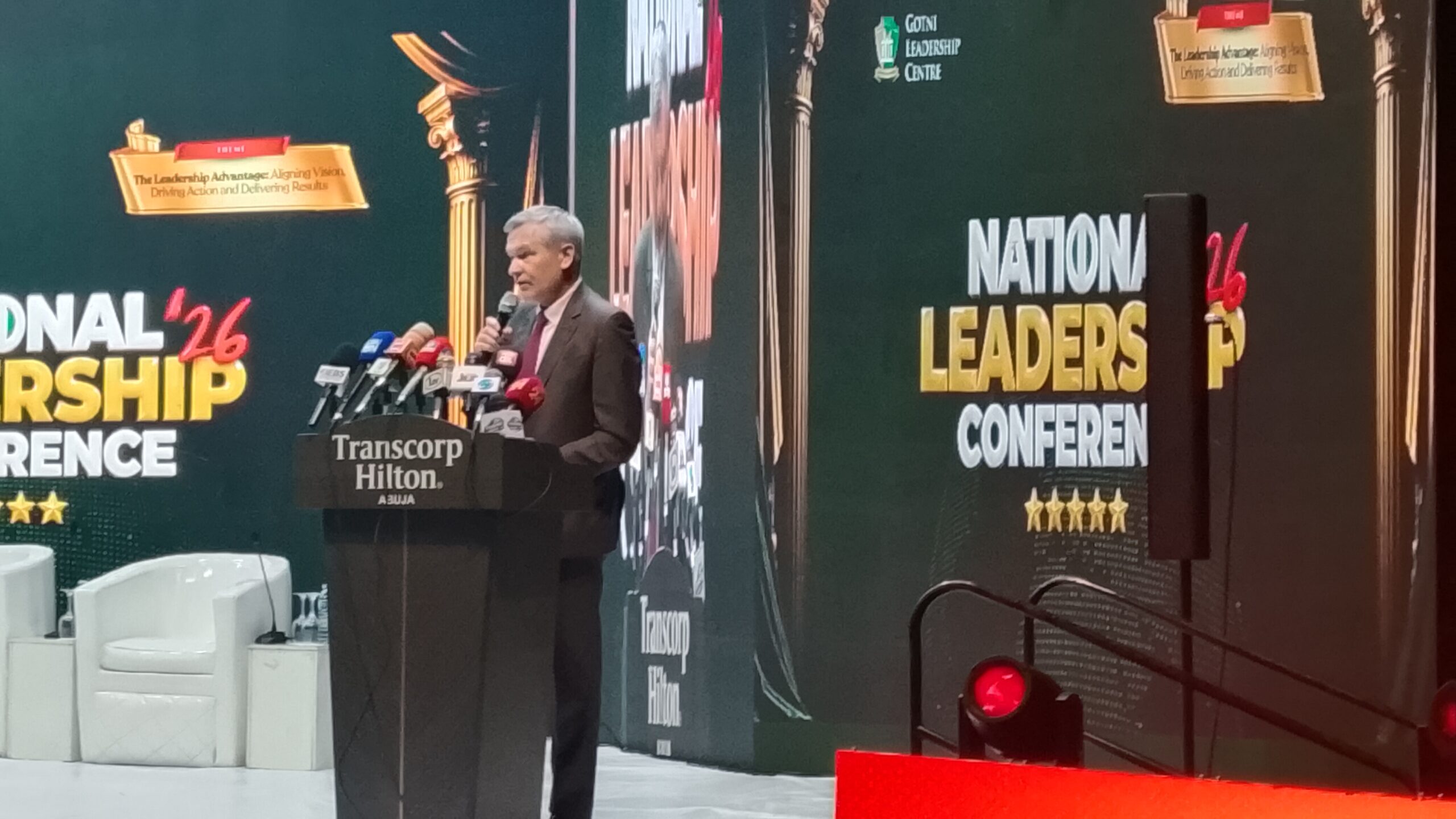
…EU Ambassador urges innovative thinking, women’s political empowerment, teamwork, diplomacy and transparent leadership
By | Goodluck E. Adubazi, Abuja
The European Union (EU) has urged Nigerian leaders to embrace setbacks as opportunities for renewal, stressing the importance of innovative thinking, teamwork, diplomacy, timing and transparency in effective leadership.
The EU delegation to Nigeria made the call on Friday at the National Leadership Conference 2026, organised by the Global Initiative for Leadership Development (GOTNI) at the Transcorp Hilton, Abuja, where the Ambassador spoke on the theme, “Leadership Advantage: Aligning Visions.”

The Ambassador also emphasised the need for greater empowerment and participation of women in political leadership, noting that leadership is not limited to people occupying formal positions of authority.


According to the Ambassador, “everyone is a leader at every point,” stressing that leadership is fundamentally about the ability to inspire, convince and mobilise others towards a common objective.
Reflecting on the history of European integration, the Ambassador said the creation of the European Economic Community offered important lessons in leadership, particularly in the areas of integration and innovative thinking.
The Ambassador noted that the European Union was established as a coalition of former enemies, describing the process as an innovative approach that also changed traditional models of international cooperation.
Unlike conventional international organisations where major decisions are often based on unanimity, the Ambassador explained that many EU decisions are taken through qualified majority voting.
Under the arrangement, decisions require the support of member states representing at least 55 per cent of EU member states and 65 per cent of the bloc’s total population, with such decisions binding even on countries that voted against them.
The Ambassador contrasted this with regional integration arrangements such as the Economic Community of West African States (ECOWAS), which still operates largely on the principle of unanimity.
According to the Ambassador, majority voting can actually encourage consensus because member states seek compromises rather than risk being consistently outvoted.
The Ambassador said another lesson from the EU experience was the importance of innovation during difficult circumstances, citing the bloc’s response to the COVID-19 pandemic.
The Ambassador explained that when COVID-19 vaccines became available, EU member states faced the possibility of competing against one another to secure supplies.
Instead, the 27 member states agreed to exercise their health-related responsibilities collectively, allowing vaccine contracts with major pharmaceutical companies to be negotiated at the EU level.
The arrangement, the Ambassador said, enabled the bloc to negotiate larger volumes at better prices, while ordering additional vaccines to support vulnerable countries around the world.
The Ambassador said the experience demonstrated that leaders must sometimes think beyond established procedures when circumstances demand new solutions.
Another leadership lesson, the Ambassador noted, could be found in the story of Jean Monnet, a French citizen who played a major role in inspiring the ideas behind European integration.
Monnet, the Ambassador said, never served as a president, prime minister or minister, but was able to influence national leaders through ideas, persuasion and vision.
The Ambassador stressed that leadership was therefore not necessarily about holding the highest office, but about the ability to inspire people and convince them to pursue a shared objective.
The EU envoy also urged leaders to take care of their teams, stressing that no leader can successfully pursue a difficult mission without ensuring that members of the team are properly equipped, trained, supported and motivated.
“Don’t go to war if you’re not sure that your troops will follow you efficiently,” the Ambassador said, while drawing a parallel between military leadership and organisational leadership.
The Ambassador further advised leaders to resolve internal conflicts through diplomacy rather than authoritarianism, stressing that authoritarianism should not be confused with effective leadership.
“Diplomacy starts” with addressing internal issues and conflicts, the Ambassador noted, urging leaders to prioritise dialogue and constructive engagement.
On decision-making, the Ambassador emphasised the importance of timing, saying that good ideas sometimes require time to mature before they can be successfully implemented.
The Ambassador advised leaders against making important decisions while angry or impulsive, noting that allowing time for reflection could result in clearer judgment.
The Ambassador also urged leaders to focus their resources and energy on the most important breakthrough they seek to achieve.
Drawing from the military concept of Schwerpunkt, described as the focal point where efforts are concentrated, the Ambassador said leaders should avoid spreading resources too thinly and instead concentrate on priority objectives.
The Ambassador recalled the experience of serving as French Ambassador to Colombia during the COVID-19 pandemic, when thousands of French citizens were stranded in the country and needed to be repatriated.
The embassy, the Ambassador said, effectively redirected its attention towards the repatriation exercise, temporarily prioritising the emergency mission over less urgent activities.
The experience, the Ambassador explained, demonstrated the importance of focusing organisational resources on the most critical mission during an emergency.
The Ambassador further said leaders must sometimes adapt established procedures when extraordinary circumstances make conventional approaches impractical.
During the COVID-19 response in Colombia, for instance, embassy officials could not operate from a conventional crisis room because of health restrictions.
Officials were therefore permitted to work remotely, including from personal computers, despite the fact that such devices had previously been prohibited for certain official activities.
The Ambassador said the decision demonstrated that leaders must understand the purpose behind rules and be prepared to adapt procedures when necessary to achieve legitimate objectives.
On leadership development, the EU Ambassador advised leaders to critically analyse the performance of those above them, identifying both their strengths and weaknesses.
According to the Ambassador, leaders can learn from good leaders by replicating or improving successful practices, while the mistakes and shortcomings of poor leaders can equally provide important lessons.
The Ambassador also encouraged leaders to be truthful and courageous enough to advise their superiors when they believe improvements are necessary.
Such advice, the Ambassador said, could be difficult, particularly when a leader is angry, but honest feedback remains an important expression of loyalty.
However, the Ambassador stressed that loyalty should ultimately be directed towards the institution or organisation.
“If your leader persists in what you think is the wrong direction and is damaging or putting at risk the institution or the company, you have to report it,” the Ambassador said.
The EU envoy also called for self-criticism and self-analysis, urging leaders to recognise their achievements while honestly acknowledging their shortcomings.
The Ambassador cautioned leaders against relying exclusively on praise, noting that senior officials often receive positive feedback from people who may be reluctant to point out their weaknesses.
Leaders, the Ambassador said, should therefore remain open to constructive criticism, particularly when it comes from people who are rational, objective and not acting out of anger or bias.
The Ambassador recommended consulting peers, coaches and staff members to obtain a broader understanding of one’s leadership performance.
The use of anonymous feedback mechanisms, the Ambassador said, could also help leaders obtain more honest assessments from members of their teams.
According to the Ambassador, such surveys can provide leaders with useful information about what they are doing well and areas requiring improvement.
The Ambassador said the ultimate test of leadership was the ability to get others to follow, particularly when navigating uncharted territory, while ensuring that the direction being pursued is appropriate.
Turning to the EU-Nigeria partnership, the Ambassador said there were opportunities for Nigerian organisations to benefit from EU-funded programmes, but clarified that the EU itself does not generally distribute grants or loans directly to Nigerian organisations.
Rather, the Ambassador explained, funding is provided through implementing partners and established programmes.
The Ambassador cited programmes such as Erasmus for students and scholars, as well as opportunities within EU-supported organisations, noting that applications are generally processed through calls for proposals or calls for applications.
The Ambassador said this approach reflected another important leadership principle: transparency.
The Ambassador described transparency as one of the most important qualities and assets a new leader can possess, urging participants to make it a central component of their leadership practice.



The Leadership Advantage: ” Aligning Vision. Driving Action. Delivering Results.