
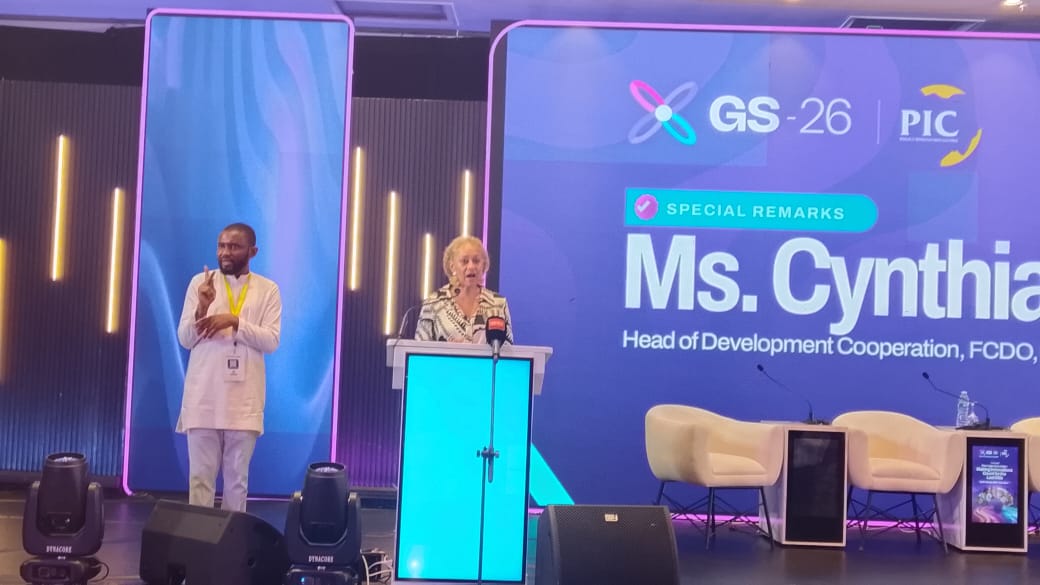
— FCDO Official Urges Nigeria, Partners to Move From Commitments to Measurable Implementation
By| Goodluck E.Adubazi, Abuja
The United Kingdom has reaffirmed its commitment to deepening its strategic partnership with Nigeria to advance women’s economic empowerment, leadership, girls’ education and the fight against gender-based violence, with a call for innovation and policy commitments to translate into practical and measurable action.
The Head of Department for Cooperation at the Foreign, Commonwealth and Development Office (FCDO), British-Nigeria, Ms Cynthia Rowe, made the remarks on Tuesday in Abuja at the Gender and Inclusion Summit 2026 (GS-26), themed: “From Agenda to Action: Making Innovation Count for the Last Mile.”
Rowe said the UK-Nigeria relationship was built on shared priorities and practical collaboration, stressing that sustainable solutions must be led by Nigerian institutions, communities and innovators.
She said the UK-Nigeria Strategic Partnership had enabled both countries to work together to build sustainable systems, expand women’s economic empowerment and leadership, and address barriers preventing women from fully participating in economic and social life.
According to her, one of the major obstacles to economic equality remains gender-based violence, which must be confronted if societies are to achieve inclusive growth and sustainable development.
Rowe said the UK was committed to supporting community-led efforts aimed at protecting women and girls, particularly in communities experiencing social, political and economic challenges.
She noted that women and girls in North-East Nigeria continued to suffer disproportionately from the effects of conflict and displacement, making it imperative for governments and development partners to strengthen protection systems while creating economic opportunities.
“In North-Eastern Nigeria, where conflict and displacement continue to disproportionately affect women and girls, we are working with partners to strengthen protection for displaced populations,” she said.
“At the same time, we need to continue supporting efforts that create economic opportunities and strengthen the systems that enable women and girls to thrive.”
The FCDO official also linked gender inclusion to the broader security agenda, saying lasting peace could not be achieved through security responses alone.
She said sustainable security required strong community institutions, economic opportunities and meaningful participation of women in decision-making processes.
“Security and inclusion are mutually reinforcing,” Rowe said, stressing that safer societies could not be built without tackling violence against women and girls.
She added that inclusive economic growth would remain difficult to achieve as long as women continued to face barriers to participation and opportunities.
Rowe said Africa was witnessing significant opportunities for transformation through technology, finance, education, healthcare and improved service delivery, but warned that innovation must be deliberately scaled beyond individual communities and pilot programmes.
She said the real challenge was whether policymakers, governments and development partners were willing to listen to people closest to the problems, invest in locally developed solutions and create systems capable of taking successful ideas to scale.
“Change can impact the lives of many people at scale,” she said.
“Often, as these examples demonstrate, the innovation that we are looking for is already there and is homegrown.
“The challenge is whether we listen to the people closest to the problems, whether we invest in what they build, and whether we create the systems that allow good ideas to move beyond one community or one programme.”
She described such an approach as the true essence of scaling innovation, noting that gatherings such as the GS-26 were important because they brought together policymakers, innovators, development partners and communities to move from discussions to implementation.
Rowe, however, cautioned that the success of the summit should not be measured merely by the quality of conversations or the calibre of participants.
According to her, the real test would be whether discussions at the summit would influence funding decisions, implementation priorities and accountability mechanisms after participants leave Abuja.
“The success of this summit cannot simply be that we have the right people in the room or the right conversations on stage,” she said.
“The Policy Innovation Centre has done its part, and now it is time for all of us to do ours by translating the conversations, challenges and even disagreements that emerge from these discussions into action and priorities.”
She said such actions must determine what gets funded, what policies are implemented, what changes and who is held accountable.
The FCDO official commended the Policy Innovation Centre (PIC) for creating mechanisms, including a commitment tracker, aimed at ensuring that pledges made at the summit do not end with speeches and declarations.
She said she was encouraged by efforts to establish accountability structures that would ensure commitments made at the summit were followed through.
Rowe also highlighted the importance of bringing girls’ education into the broader conversation on gender inclusion, saying a special session would examine the relationship between girls’ education and child marriage.
The session, she said, would focus on what it would take to move existing policies beyond paper commitments into properly funded implementation.
On women’s participation in leadership and governance, Rowe stressed that countries could not fully achieve their development ambitions without placing women at the centre of decision-making.
She said this required greater representation of women in politics, corporate boards and other positions where critical decisions affecting societies were made.
“I believe we will only achieve our ambitions when we include women,” she said.
“That means women in politics, women on boards and women making important decisions.”
Rowe said the United Kingdom looked forward to continuing its collaboration with Nigeria and other development partners to transform shared ambitions into practical progress.
She expressed hope that the outcome of GS-26 would enable more women and girls to live free from violence, participate fully in society and benefit from improved economic opportunities and security.
As the two-day summit commenced, Rowe challenged participants to become “impact brokers” by working collectively to connect ideas, resources, institutions and communities in ways that would deliver meaningful change.
She urged participants not to allow the discussions at GS-26 to end within the conference halls but to ensure that the commitments and priorities emerging from the summit translated into real-life improvements for women, girls and communities across Nigeria.
The Gender and Inclusion Summit 2026, organised by the Policy Innovation Centre, brought together government officials, development partners, policymakers, civil society organisations, innovators and other stakeholders to explore practical solutions for advancing gender equality and inclusion.
The message from the GS-26 summit, Rowe said, must be clear: the time has come to move from agenda-setting to action, ensuring that innovation reaches the people and communities who need it most.