By| Goodluck E.Adubazi, Abuja
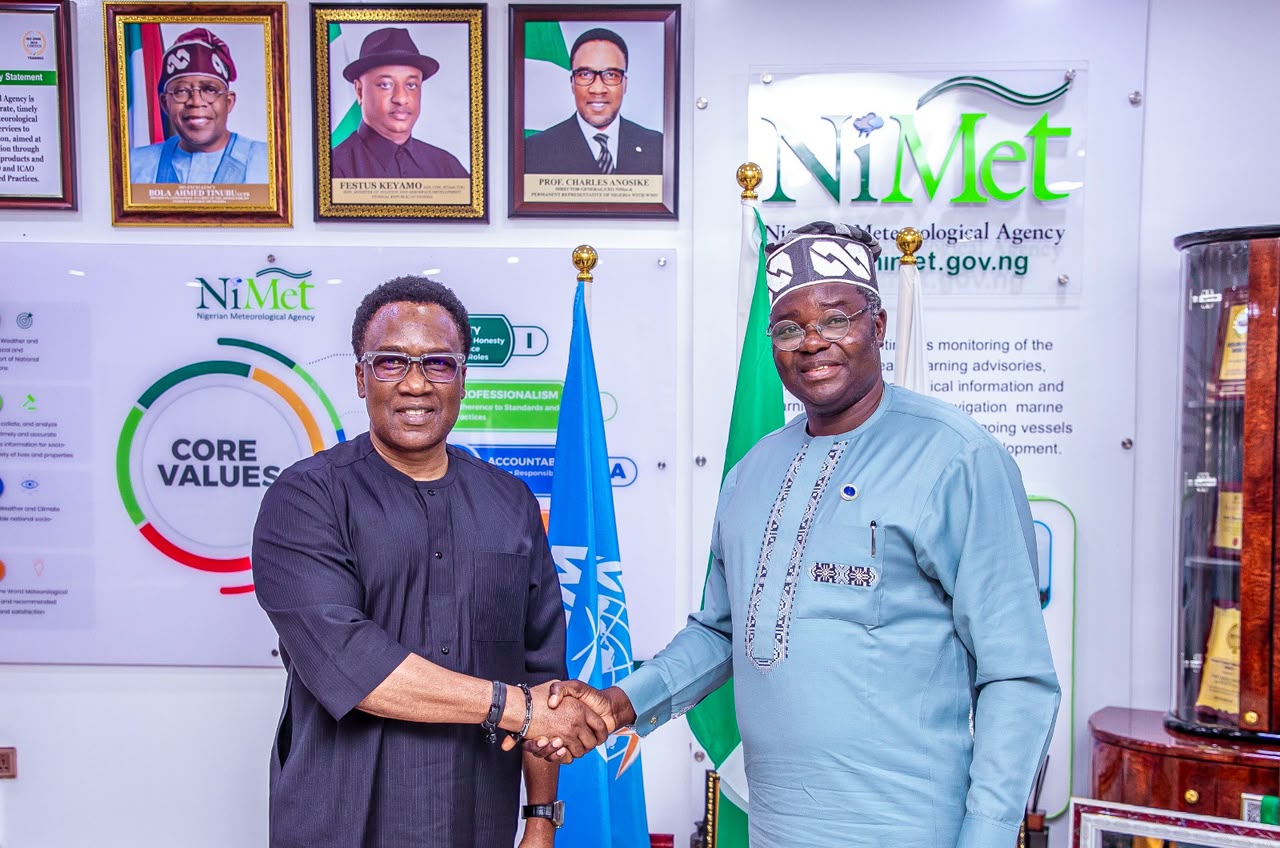
The Nigerian Meteorological Agency (NiMet) and the National Space Research and Development Agency (NASRDA) have strengthened their partnership to enhance earth system observations aimed at supporting sustainable national development and improving service delivery across key socioeconomic sectors.
The renewed commitment was reached on Thursday during a courtesy visit by the Director-General and Chief Executive of NASRDA, Dr. Matthew Adepoju, to the Director-General and Chief Executive Officer of NiMet, Prof. Charles Anosike, in Abuja.
The two agencies agreed to deepen collaboration by leveraging their respective mandates to provide more accurate and reliable earth observation data to support national planning, climate resilience, disaster preparedness and economic development.
Speaking during the meeting, Prof. Anosike reaffirmed NiMet’s commitment to strengthening its long-standing relationship with NASRDA, stressing that meteorological observations remain critical to safeguarding lives and property, supporting climate-smart decision-making and enhancing anticipatory actions against weather-related hazards.
He also highlighted NiMet’s ongoing efforts to adopt emerging technologies, including Artificial Intelligence (AI), to improve weather forecasting and service delivery.
On his part, Dr. Adepoju proposed closer collaboration on the development of a Nigerian meteorological satellite, a move he said would position the country as a continental leader in space weather observation.
He identified other areas for partnership to include meteorological support for the operationalisation of hot-air balloons, joint capacity building, knowledge exchange and specialised training programmes.
The two chief executives also underscored the need for greater private sector participation in developing Nigeria’s earth observation systems to unlock innovation and accelerate national development.
To strengthen the partnership, both agencies agreed to review and update their existing Memorandum of Understanding (MoU), making it more forward-looking, actionable and aligned with measurable national development goals.
The renewed collaboration is expected to enhance Nigeria’s capacity in weather forecasting, climate monitoring, disaster risk reduction, space science and environmental management, while supporting evidence-based policymaking and sustainable socioeconomic development.