
By| Goodluck E.Adubazi, Abuja
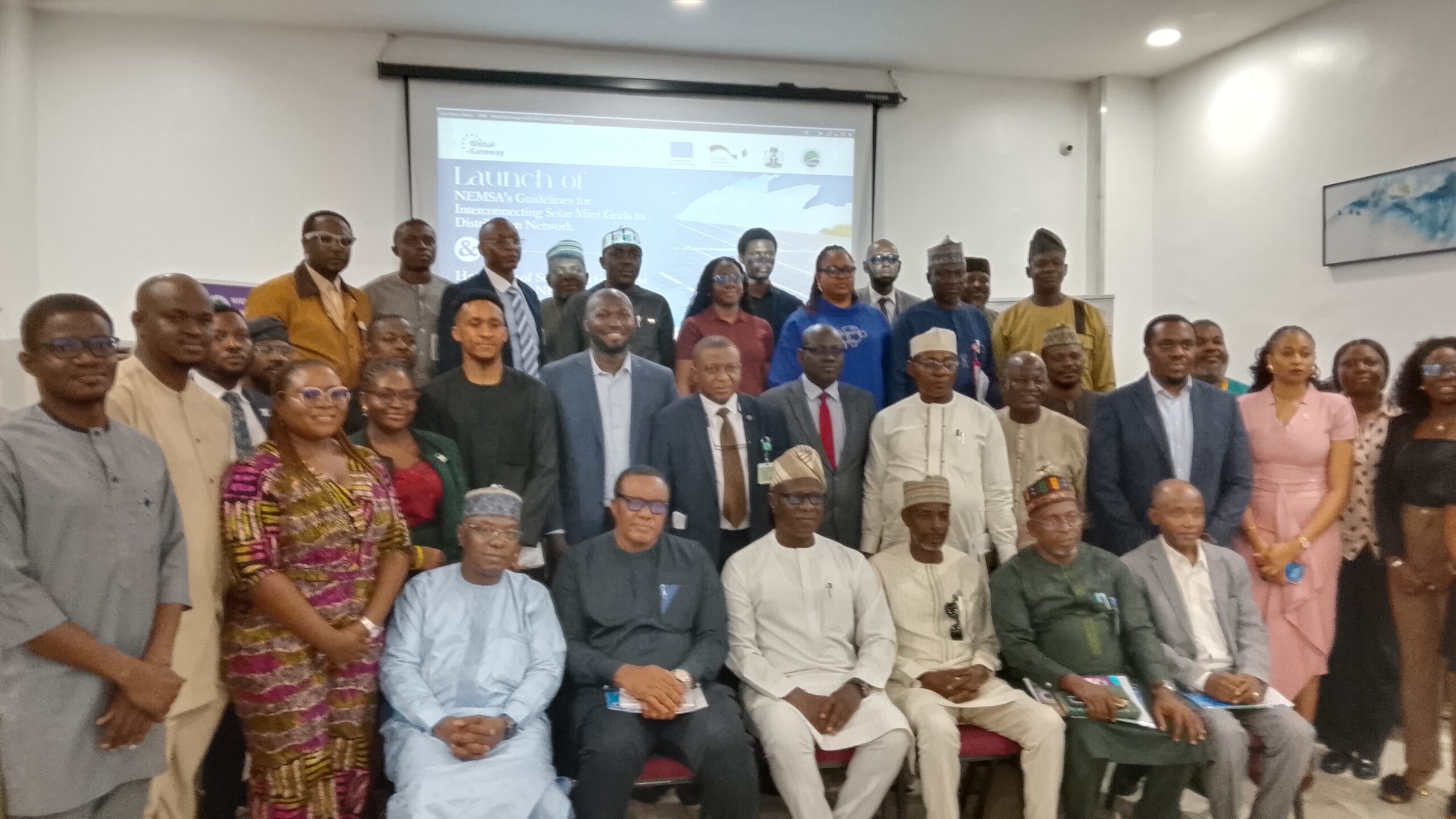
In a major step towards accelerating renewable energy deployment and expanding electricity access across Nigeria, the Federal Ministry of Power, the Nigerian Electricity Management Services Agency (NEMSA), the European Union (EU), the German Government, GIZ, and the Global Gateway initiative on Tuesday officially launched the Guidelines for Interconnecting Solar Mini-Grids to Distribution Networks and handed over advanced solar testing equipment to NEMSA.


The event, held in Abuja, marks a significant milestone in the implementation of Section 9 of the Mini-Grid Regulations 2026, which provides the framework for connecting solar mini-grids to existing electricity distribution networks across the country.


The new guidelines are designed to ensure the safe, efficient and sustainable integration of interconnected solar mini-grids into Nigeria’s electricity distribution infrastructure while maintaining grid stability, power quality, system reliability and public safety.
Speaking at the launch, Managing Director and Chief Executive Officer of NEMSA, and Chief Electrical Inspector of the Federation, Engr. Olusegun Adesayo, described the initiative as a major milestone in Nigeria’s journey toward a safer, more reliable and inclusive electricity sector.
According to him, solar mini-grids have become a critical solution for providing electricity to unserved and underserved communities across the country, helping to bridge Nigeria’s energy access gap.
He noted that the rapid expansion of interconnected solar mini-grids has created an urgent need for clear technical and regulatory frameworks to govern their integration into existing distribution networks.
“The guidelines provide comprehensive procedures, technical requirements, interconnection models and operational standards for integrating solar mini-grids into distribution networks without compromising grid stability, power quality, system reliability and public safety,” Adesayo said.
He added that the document would reduce uncertainty for investors and developers while promoting stronger collaboration among distribution companies, mini-grid developers, regulators and other stakeholders.
The NEMSA boss emphasized that the guidelines align with the Electricity Act 2023, the Mini-Grid Regulations 2026, and relevant national and international standards, including those of the International Electrotechnical Commission (IEC).
“We are confident that this document will significantly enhance investor confidence and accelerate the deployment of interconnected renewable energy systems across Nigeria,” he stated.
Adesayo also commended the Nigerian Energy Support Programme (NESP), the European Union, the German Government, GIZ, the Federal Ministry of Power and other stakeholders for their technical and institutional support in developing the guidelines.

Speaking at the event, Dr. Kavin Jaseu, First Secretary and Head of Development Cooperation at the German Embassy in Nigeria, described the launch as a major achievement for Nigeria’s growing solar mini-grid sector.
She noted that Nigeria has emerged as one of Africa’s fastest-growing solar mini-grid markets, driven by strong government commitment, private sector participation and support from international development partners.
“As the market continues to grow and mature, it is essential that this growth is supported by the right technical standards, effective oversight mechanisms and clear guidance that promotes uniformity, safety, quality and investor confidence,” Jansen said.
She expressed confidence that the new guidelines would provide clear direction for developers, electricity distribution companies, financiers, development partners and new market entrants.
According to her, the guidelines will ensure that interconnected solar mini-grids are developed safely and efficiently while remaining aligned with international best practices.
Jaseu further highlighted Germany’s continued support for Nigeria’s energy transition through the Nigerian Energy Support Programme (NESP), funded by the German Federal Ministry for Economic Cooperation and Development (BMZ).
She said Germany was pleased to support both the development of the guidelines and the procurement of solar testing equipment for NEMSA, which would strengthen the agency’s inspection, quality assurance and compliance capabilities.
Also speaking, Head of Cooperation of the European Union Delegation to Nigeria and ECOWAS, Massimo De Luca, stressed the importance of maintaining high technical standards in the growing interconnected mini-grid market.
De Luca noted that interconnected mini-grids have become a key model for expanding electricity access in Nigeria and across Africa, contributing significantly to the objectives of the Mission 300 initiative aimed at increasing energy access on the continent.
He disclosed that the EU and German cooperation programmes have supported the development of several interconnected mini-grid projects in Nigeria, with more projects nearing completion.
“As the interconnected mini-grid model continues to expand, standards are essential. The quality of integration between mini-grids and distribution company networks directly affects the quality of electricity delivered to citizens,” he said.
He urged distribution companies, mini-grid developers, financiers, technical service providers and other stakeholders to ensure full compliance with the new guidelines.
De Luca emphasized that NEMSA has a critical role not only as a regulator and standards setter but also as an institution responsible for ensuring that all parties comply with the established standards.
He noted that the guidelines were developed based on practical experience gained from successfully implementing interconnected mini-grid projects under the Nigerian Energy Support Programme.
Representing the Permanent Secretary of the Federal Ministry of Power, Engr. Mustapha Baba Umar, Director of Distribution Services, described the guidelines as a timely intervention that would support the rapid growth of renewable energy in Nigeria.
He said the increasing deployment of solar mini-grids presents new technical and operational challenges that require standardized procedures and effective coordination among stakeholders.
A goodwill message from the Managing Director of the Transmission Company of Nigeria (TCN) also endorsed the initiative, describing the guidelines as critical to ensuring safe and efficient integration of renewable energy systems into the national electricity network.
According to NEMSA, the guidelines establish the processes, standards, technical requirements and stakeholder responsibilities for the interconnection of solar mini-grids with electricity distribution networks.
The document will be enforced by NEMSA and implemented by electricity distribution licensees in collaboration with mini-grid developers.
The guidelines are to be applied alongside existing laws and regulations, including:The Electricity Act 2023 , NERC Mini-Grid Regulations 2026 , Nigerian Electricity Health and Safety Code 2014, Nigerian Electricity Supply and Installation Standards (NESIS) Regulations 2015; Grid Code 2018; Distribution Code 2014; Metering Code Version 02 (2014); Nigerian Electricity Smart Metering Regulations 2015; and other applicable NERC regulations and technical standards. NEMSA said the guidelines would be reviewed every three years or earlier if necessary.
The guidelines recognize several approved models for integrating solar mini-grids into distribution networks, including: Small Power Producer (SPP): Mini-grid developers generate electricity and inject power into the distribution network, while distribution companies retail electricity to customers. Small Power Distributor (SPD): Developers decommission generation assets, purchase electricity in bulk from distribution companies and retail it to customers within the mini-grid area. Hybrid Model (SPP/SPD): Combines generation and distribution functions.
Compensation Buy-Out Model.Time-Split Supply Model (TSS). Other interconnection arrangements permitted under regulatory frameworks.
Industry stakeholders at the event described the launch as a landmark development that could accelerate private sector investment in renewable energy, improve electricity access in underserved communities and strengthen Nigeria’s transition toward a more sustainable and resilient power sector.
With the official launch of a unified technical framework and enhanced regulatory oversight, the new guidelines are expected to pave the way for wider deployment of interconnected solar mini-grids, helping Nigeria meet its energy access and clean energy goals while improving electricity supply for millions of citizens.